Measuring Actomyosin Bundle Viscoelasticity with QCM-D: A Complete Protocol Guide for Biomechanics Research
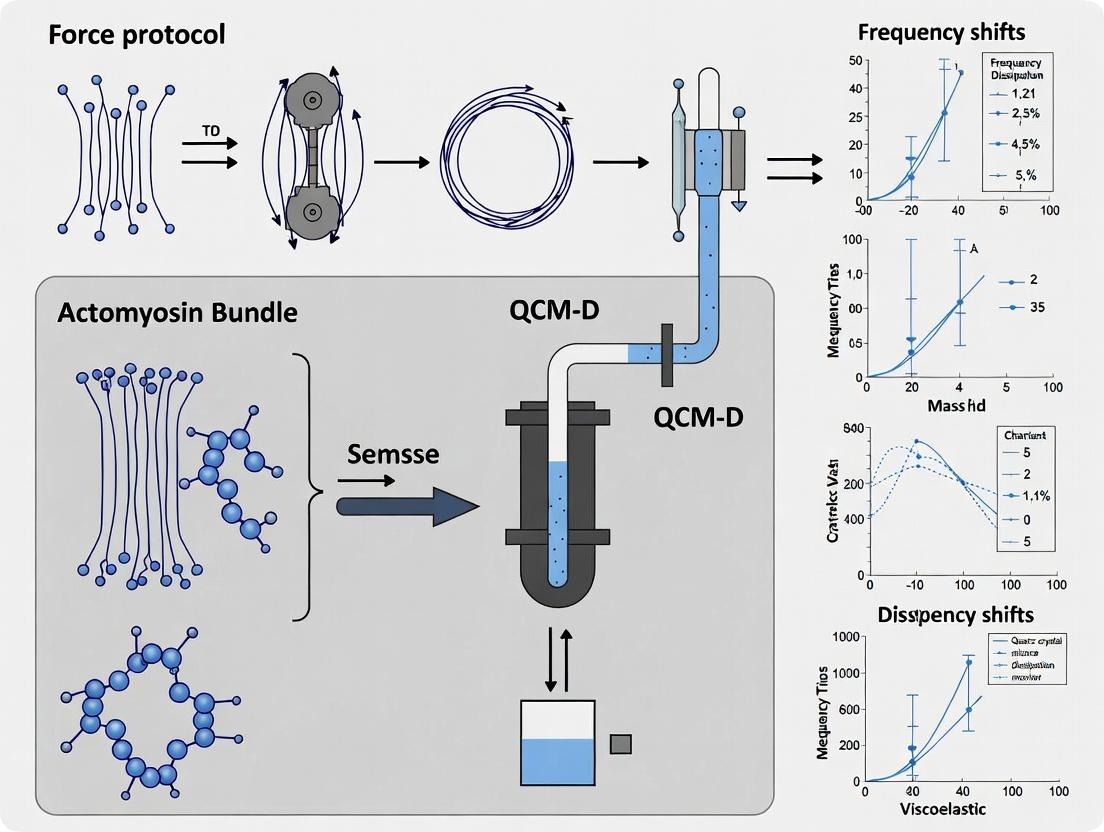
This article provides a comprehensive guide to using Quartz Crystal Microbalance with Dissipation (QCM-D) for quantifying the viscoelastic properties of reconstituted actomyosin bundles and networks.
Measuring Actomyosin Bundle Viscoelasticity with QCM-D: A Complete Protocol Guide for Biomechanics Research
Abstract
This article provides a comprehensive guide to using Quartz Crystal Microbalance with Dissipation (QCM-D) for quantifying the viscoelastic properties of reconstituted actomyosin bundles and networks. It covers foundational principles of the technique and the actomyosin cytoskeleton, detailing a step-by-step experimental protocol from surface preparation to data acquisition. The guide addresses common troubleshooting scenarios and optimization strategies for reliable measurements. Finally, it validates QCM-D data against established techniques like AFM and optical trapping, positioning QCM-D as a powerful, label-free tool for fundamental biophysics research and drug discovery targeting cytoskeletal mechanics in diseases like cancer and cardiovascular disorders.
Understanding Actomyosin Mechanics and the QCM-D Principle: Why Viscoelasticity Matters
Actomyosin bundles are supramolecular assemblies of actin filaments and myosin II motor proteins that form crucial structural scaffolds in eukaryotic cells. They are the primary force-generating and tension-bearing elements within the cytoskeleton, essential for processes like cytokinesis, cell migration, tissue morphogenesis, and maintenance of cellular stiffness. Their viscoelastic properties, a combination of elastic solid and viscous fluid behaviors, are central to their function and are dysregulated in diseases ranging from cancer to cardiovascular disorders. This article, framed within a thesis investigating Quartz Crystal Microbalance with Dissipation (QCM-D) protocols for measuring actomyosin bundle viscoelasticity, provides detailed application notes and protocols for their in vitro reconstitution and study.
Experimental Protocols
Protocol 1:In VitroReconstitution of Minimal Actomyosin Bundles for QCM-D Studies
This protocol describes the assembly of contractile actomyosin bundles from purified components on a functionalized surface, suitable for subsequent QCM-D measurement.
Materials:
- G-buffer (5 mM Tris-HCl pH 8.0, 0.2 mM CaCl₂, 0.2 mM ATP, 1 mM DTT).
- F-buffer (10 mM Imidazole pH 7.4, 50 mM KCl, 1 mM MgCl₂, 1 mM EGTA, 0.2 mM ATP, 1 mM DTT).
- Purified skeletal muscle or non-muscle myosin II (or HMM, heavy meromyosin).
- Purified actin (e.g., from rabbit muscle).
- Fascin or α-actinin (for cross-linking).
- QCM-D sensor chips (SiO₂ or TiO₂ coated).
- N-ethyl-N'-(3-dimethylaminopropyl)carbodiimide (EDC)/N-hydroxysuccinimide (NHS) chemistry reagents.
- Poly-L-lysine (PLL) or specific anti-actin/myosin antibodies for surface immobilization.
- QCM-D instrument (e.g., QSense Analyzer).
Method:
- Sensor Surface Functionalization: a. Clean QCM-D sensor chips in a 2% Hellmanex III solution, followed by UV/Ozone treatment. b. For amine coupling: Inject a 0.1 mg/mL PLL solution in 10 mM HEPES (pH 5.5) over the chip surface for 30 min. Wash with running buffer (F-buffer). c. Alternatively, covalently link primary antibodies using a standard EDC/NHS amine coupling protocol.
Actin Polymerization and Bundle Formation: a. Prepare monomeric G-actin (3 µM) in G-buffer. Initiate polymerization by adding 1/10 volume of 10x F-buffer. b. Immediately add the cross-linker (e.g., fascin at a 1:5 molar ratio to actin) and myosin II (50-100 nM). Mix gently. c. Immediately inject the mixture over the functionalized QCM-D sensor surface. Incubate for 60 minutes at 25°C to allow bundle formation and attachment. d. Wash extensively with F-buffer to remove unbound material.
QCM-D Measurement Initiation: a. Establish a stable baseline in F-buffer (with ATP). b. Initiate real-time measurement of frequency (Δf, related to mass) and dissipation (ΔD, related to viscoelasticity) shifts. c. To induce contraction, perfuse with F-buffer containing 2 mM MgATP. Observe changes in Δf and ΔD.
Protocol 2: Viscoelasticity Analysis via QCM-D Data Modeling
This protocol outlines the steps for deriving viscoelastic parameters from QCM-D (Δf, ΔD) data.
Method:
- Data Pre-processing: Clean data using the QSoft or equivalent software. Select stable overtone data (typically 3rd, 5th, 7th).
- Model Selection: For homogeneous, moderately rigid adlayers (like bundled networks), use the Sauerbrey model for initial mass estimation: Δm = -C * (Δf_n / n), where C is the sensitivity constant (17.7 ng cm⁻² Hz⁻¹ for a 5 MHz crystal), n is the overtone number.
- Viscoelastic Modeling: For soft, dissipative layers, fit Δf and ΔD for multiple overtones to a Voigt-based viscoelastic model. The model treats the adlayer as a homogeneous material characterized by shear elasticity (μ, Pa), shear viscosity (η, Pa·s), and thickness (d, m).
- Fitting Procedure: Use integrated software (e.g., Dfind) to fit the data. Constrain layer density to 1100-1300 kg m⁻³. A good fit is indicated by low χ² values and the model curve passing through all overtone data points.
- Parameter Extraction: Report the fitted values for shear storage modulus (G' = μ), loss modulus (G'' = ωη), and loss tangent (tan δ = G''/G').
Data Presentation
Table 1: Typical QCM-D Response and Derived Viscoelastic Parameters for Reconstituted Actomyosin Structures
| Sample Composition | Δf₃ (Hz) | ΔD₃ (1e-6) | Sauerbrey Mass (ng/cm²) | Shear Elasticity, G' (kPa) | Shear Viscosity (Pa·s) | Loss Tangent (tan δ) |
|---|---|---|---|---|---|---|
| Actin Filaments Only | -25.5 ± 3.2 | 2.1 ± 0.5 | 452 ± 57 | 12.5 ± 2.1 | 0.003 ± 0.001 | 0.08 |
| Actin + Fascin Bundles | -48.7 ± 5.1 | 5.8 ± 1.2 | 863 ± 90 | 85.3 ± 10.5 | 0.015 ± 0.004 | 0.06 |
| Actin + Myosin II (No ATP) | -52.1 ± 6.0 | 8.5 ± 1.5 | 923 ± 106 | 45.2 ± 7.8 | 0.022 ± 0.005 | 0.17 |
| Actomyosin Bundle (2 mM ATP) | -35.4 ± 4.8 | 15.2 ± 2.8 | 627 ± 85 | 22.7 ± 4.3 | 0.041 ± 0.008 | 0.65 |
Note: Simulated data based on recent literature. Δf₃ and ΔD₃ are shifts for the 3rd overtone (15 MHz). ATP addition to actomyosin bundles causes contraction, increasing dissipation (ΔD) and loss tangent, indicating a more viscous, dynamically remodeling network.
Mandatory Visualization
Title: Actomyosin Bundle QCM-D Experimental Workflow
Title: QCM-D Data Analysis Decision Pathway
The Scientist's Toolkit: Research Reagent Solutions
Table 2: Essential Reagents for In Vitro Actomyosin Bundle Studies
| Reagent/Material | Function & Role in Experiment | Example Supplier/Catalog |
|---|---|---|
| Monomeric Actin (G-actin) | Core building block. Polymerizes into filaments (F-actin) that form the bundle backbone. Purity is critical for reproducible mechanics. | Cytoskeleton, Inc. (AKL99) |
| Myosin II (Skeletal or Non-muscle) | The molecular motor. Generates contractile force by sliding actin filaments upon ATP hydrolysis. | Cytoskeleton, Inc. (MY02) |
| Fascin | Actin-bundling protein. Creates tightly packed, parallel bundles with specific spacing, increasing bundle stiffness. | Abcam (ab126772) |
| α-Actinin | Actin cross-linking protein. Forms more elastic, gel-like networks by creating looser, orthogonal connections between filaments. | Sigma (A7732) |
| ATP (Adenosine Triphosphate) | Fuel for myosin motors. Its addition initiates contraction; its removal arrests activity. Critical for dynamic measurements. | Roche (10127523001) |
| Quartz Crystal Microbalance with Dissipation (QCM-D) Instrument | Label-free surface-sensitive technique to measure real-time changes in adsorbed mass and viscoelastic properties. | Biolin Scientific (QSense Explorer) |
| SiO₂/TiO₂ Coated QCM-D Sensors | Provide a hydrophilic, biocompatible surface for protein immobilization and bundle attachment. | Biolin Scientific (QSX 303/QSX 310) |
| Poly-L-Lysine (PLL) | A cationic polymer for non-specific electrostatic adsorption of negatively charged proteins/structures to the sensor surface. | Sigma (P8920) |
Within the broader thesis investigating a Quartz Crystal Microbalance with Dissipation (QCM-D) protocol for measuring the viscoelasticity of reconstituted actomyosin bundles, this document details the critical biological context. Viscoelasticity—the property of materials exhibiting both viscous (liquid-like) and elastic (solid-like) behavior—is a fundamental mechanical regulator across biological scales. Understanding its measurement in core cytoskeletal components like actomyosin is paramount for deciphering its role in complex physiological and developmental processes, from single-cell migration to coordinated tissue shaping.
Application Notes: Biological Roles of Viscoelasticity
Cellular Scale: Motility and Division
At the cellular level, the viscoelastic cytoplasm and its actomyosin cortex determine shape, mechanical response, and movement.
- Cell Migration: The leading edge exhibits softer, more fluid-like properties for protrusion, while the cell body and rear are more elastic, facilitating contraction and retraction. This spatial viscoelastic gradient is essential for persistent migration.
- Cell Division: Successful cytokinesis requires precise temporal regulation of cortical viscoelasticity. A transition to a more elastic state stabilizes the cleavage furrow, driven by actomyosin contraction.
Key Quantitative Data (Cellular Scale): Table 1: Representative Viscoelastic Parameters in Cellular Processes
| Process/Component | Elastic Modulus (G', Pa) | Viscous Modulus (G'', Pa) | Measurement Technique | Biological Implication |
|---|---|---|---|---|
| Cytoplasm (General) | 100 - 1,000 | ~50 - 500 | AFM, Microrheology | Sets permissive environment for organelle transport. |
| Actomyosin Cortex | 500 - 5,000 | 200 - 2,000 | AFM, Optical Tweezers | Maintains cell tension and shape. |
| Migrating Cell Front | 100 - 500 | ~50 - 300 | Particle Tracking Microrheology | Enables facile actin polymerization & membrane protrusion. |
| Cleavage Furrow | >2,000 | Variable (often lower) | Ferromagnetic Beads | Provides mechanical stability for fission. |
Tissue Scale: Morphogenesis and Homeostasis
Tissues are viscoelastic materials whose properties emerge from the ECM and cellular mechanics.
- Epithelial Folding & Budding: Localized changes in cell contractility (via actomyosin) and adhesion alter tissue viscoelasticity, driving bending and invagination events.
- Mechanical Memory: Tissues can retain a memory of past mechanical stimuli (e.g., stretching) through viscoelastic remodeling of the actomyosin cytoskeleton and ECM, influencing future growth and differentiation.
Key Quantitative Data (Tissue Scale): Table 2: Viscoelastic Parameters in Tissue Contexts
| Tissue/Context | Elastic Modulus (E or G', kPa) | Loss Tangent (tan δ = G''/G') | Measurement Technique | Biological Implication |
|---|---|---|---|---|
| Mammary Epithelium | ~1 - 3 kPa | ~0.1 - 0.3 | Atomic Force Microscopy | Softer state favors branching morphogenesis. |
| Developing Drosophila Wing Disc | ~1 - 10 kPa | Temporal changes observed | Microplate Rheometry | Viscoelastic relaxation aids cell rearrangement. |
| Cardiac Tissue (Healthy) | ~10 - 50 kPa (varies with direction) | Frequency-dependent | Shear Rheometry | Balanced viscosity/elasticity ensures efficient pumping. |
| Fibrotic Tissue | >50 kPa (markedly increased) | Often decreased | Multiple | Pathological stiffening disrupts function. |
Protocols: Linking Molecular Mechanics to Biology
2.1. Core Protocol: QCM-D for Reconstituted Actomyosin Bundle Viscoelasticity This protocol is central to the thesis, providing a model system to quantify the foundational viscoelasticity driven by actin and myosin.
Aim: To measure the viscoelastic properties of in vitro reconstituted actomyosin bundles in real-time under various biochemical perturbations.
Materials & Reagent Solutions: Table 3: Research Reagent Solutions for Actomyosin QCM-D
| Reagent/Material | Function/Description |
|---|---|
| QCM-D Sensor (SiO2 coated) | Provides oscillating surface for protein adsorption/bundle formation. SiO2 promotes biomimetic attachment. |
| G-Actin (Lyophilized) | Monomeric actin; building block for filament polymerization. |
| Myosin II (S1 fragment or full length) | Motor protein that crosslinks and contracts actin filaments. |
| ATP (Adenosine Triphosphate) | Biochemical fuel for myosin motor activity; its concentration regulates contractility. |
| Polymerization Buffer (Mg²⁺, K⁺, ATP) | Induces F-actin polymerization from G-actin. |
| Blebbistatin | Specific myosin II inhibitor; used as a negative control to abrogate active contraction. |
| Calyculin A | Phosphatase inhibitor; increases myosin light chain phosphorylation to upregulate contractility. |
Detailed Workflow:
- Sensor Preparation: Clean SiO2 sensor in UV-ozone cleaner for 15 min. Mount in QCM-D flow module.
- Baseline Establishment: Flow in polymerization buffer at 50 µL/min until stable frequency (Δf) and dissipation (ΔD) baselines are recorded.
- Actin Filament Adsorption: Introduce 1 µM G-actin in polymerization buffer. Allow to incubate for 20-30 min, facilitating surface-initiated polymerization into a filamentous network. Monitor Δf (mass uptake) and ΔD (softness increase).
- Actomyosin Bundle Formation: Introduce 50-100 nM myosin II in buffer containing 1 mM ATP. Flow for 10 min. Myosin crosslinks actin filaments, forming viscoelastic bundles.
- Active Viscoelasticity Measurement: Switch to buffer with 1 µM ATP (low ATP promotes strong binding and sustained tension). Record Δf and ΔD over 10-15 min. The ΔD/Δf ratio provides a signature of viscoelastic changes.
- Pharmacological Modulation (Example): Introduce buffer containing 1 µM ATP and 50 µM Blebbistatin. Observe real-time shifts in Δf and ΔD as active tension is released, revealing the contribution of motor activity to bundle elasticity.
- Data Analysis: Use a viscoelastic model (e.g., Kelvin-Voigt) applied to the odd overtone Δf and ΔD shifts to calculate the shear storage modulus (G', elasticity) and shear loss modulus (G'', viscosity) of the adsorbed layer.
2.2. Correlative Protocol: Traction Force Microscopy (TFM) on Engineered Substrates A complementary method to connect molecular viscoelasticity with cellular-scale force generation.
Aim: To measure the forces exerted by a single cell on its substrate, correlating with the known viscoelasticity of its underlying actomyosin cortex.
Detailed Workflow:
- Substrate Fabrication: Prepare a soft polyacrylamide gel (elasticity ~1-5 kPa) embedded with fluorescent microbeads.
- Cell Plating: Plate cells (e.g., epithelial, fibroblast) onto the functionalized gel.
- Imaging: Acquire time-lapse images of the fluorescent beads using confocal microscopy.
- Force Calculation: After cell detachment (via trypsin), capture a reference "relaxed" bead image. Use particle image velocimetry (PIV) algorithms to compute the displacement field of beads caused by cellular tractions. Apply Fourier-transform traction cytometry to convert displacements into a 2D traction force map.
Visualization: Pathways and Workflows
Diagram 1: QCM-D Protocol for Actomyosin Viscoelasticity
Diagram 2: Viscoelasticity in Morphogenesis Pathway
Within the thesis on developing robust QCM-D protocols for actomyosin bundle viscoelasticity research, understanding the core principle of measuring Δf and ΔD is paramount. This technique provides real-time, label-free quantification of the viscoelastic properties of biological layers adhered to a sensor surface. For actomyosin research, this translates to direct measurement of bundle formation kinetics, structural integrity, and mechanical response to biochemical perturbations, offering insights into cytoskeletal dynamics relevant to cell motility, division, and drug mechanisms.
Core Principle: The Simultaneous Measurement
A Quartz Crystal Microbalance with Dissipation monitoring (QCM-D) uses a thin piezoelectric quartz crystal disk excited at its resonant frequency. The instrument tracks two fundamental parameters:
- Frequency Shift (Δf): Primarily related to the mass (both adsorbed mass and coupled water) attached to the crystal surface. A decrease in frequency (negative Δf) indicates mass increase.
- Dissipation Shift (ΔD): Describes the damping or energy loss in the system, related to the viscoelasticity (softness/rigidity) of the adsorbed layer. A higher ΔD indicates a softer, more dissipative layer.
The simultaneous measurement allows discrimination between rigid, mass-like layers (large |Δf|, small ΔD) and soft, viscous layers (moderate |Δf|, large ΔD), which is critical for studying complex, hydrated biopolymers like actomyosin networks.
Table 1: Interpretation of Δf and ΔD Shifts for Model Systems
| Adhered Layer Type | Typical Δf (Third Overtone, ~15 MHz) | Typical ΔD (1e-6) | Physical Interpretation |
|---|---|---|---|
| Thin, Rigid Protein Monolayer | -25 to -30 Hz | < 1 | Sauerbrey regime; mass-dominated, elastic film. |
| Viscoelastic Polymer Hydrogel | -100 to -150 Hz | 10 - 50 | Soft, water-rich layer; significant dissipation. |
| Forming Actomyosin Bundle | -50 to -200 Hz (kinetic) | 2 - 20 (kinetic) | Initial binding (Δf↓, ΔD↑), then maturation/stiffening (Δf↓ further, ΔD↓). |
| Intact Cell Layer | -200 to -500 Hz | 20 - 100 | Highly viscoelastic, dynamic, and dissipative structure. |
Table 2: Key Instrument Parameters and Their Impact
| Parameter | Typical Setting/Value | Impact on Actomyosin Measurement |
|---|---|---|
| Fundamental Frequency | 5 MHz | Base resonance. Higher overtones are more sensitive to viscoelastic changes. |
| Overtone Numbers (n) | 3, 5, 7, 9, 11, 13 | Simultaneous measurement at multiple harmonics allows film homogeneity assessment and modeling. |
| Temperature Control | 25°C or 37°C ± 0.02°C | Critical for protein activity (e.g., myosin ATPase) and bundle stability. |
| Flow Rate | 50 - 100 µL/min | Controls shear, reagent delivery, and minimizes nonspecific settling. |
Application Notes for Actomyosin Research
Note 1: Distinguishing Binding from Rigidification. During bundle formation, initial actin and myosin binding often shows a concurrent negative Δf and positive ΔD. Subsequent bundle maturation (e.g., via cross-linking, myosin motor activity) may cause further Δf decrease but a decrease in ΔD, indicating structural stiffening—a key measurable outcome.
Note 2: Modeling Viscoelasticity. Δf and ΔD data from multiple overtones can be fitted with viscoelastic models (e.g., Kelvin-Voigt) to extract quantitative parameters: shear elasticity (μ), shear viscosity (η), and thickness (d) of the actomyosin layer.
Note 3: Drug Effect Profiling. Compounds targeting cytoskeletal dynamics (e.g., Myosin II inhibitors like Blebbistatin, actin stabilizers like Phalloidin) induce characteristic Δf/ΔD kinetic signatures, allowing for dose-response and mechanistic studies.
Detailed Experimental Protocols
Protocol 1: Baseline Measurement of Actomyosin Bundle FormationIn Situ
Objective: To measure the kinetics and viscoelastic evolution of actomyosin bundles forming on a functionalized QCM-D sensor surface.
Materials: See "The Scientist's Toolkit" below.
Procedure:
- Sensor Preparation: Mount a silica (SiO₂) or gold sensor in the QCM-D chamber. Establish a stable baseline with running buffer (e.g., BRB80) at 50 µL/min, 25°C.
- Surface Functionalization: Passivate with 0.1% BSA for 10 min to minimize nonspecific binding. Rinse with buffer.
- Nucleation Site Creation: Inject 50 µg/mL N-ethylmaleimide (NEM)-myosin (rigor mutant) or an anti-His tag antibody (for His-tactin) for 10 min. This creates immobilized "seeds" or anchors. Rinse thoroughly.
- Initiate Bundle Assembly: Co-inject a mixture containing:
- 2-4 µM G-actin (in G-buffer)
- 1-2 µM active myosin II (or HMM)
- Polymerization/bundle buffer (1 mM MgCl₂, 50 mM KCl, 1 mM ATP in BRB80).
- Data Acquisition: Record Δf and ΔD at overtones 3, 5, 7, 9, 11, and 13 in real-time for 60-90 minutes until signals stabilize.
- Buffer Rinse: Switch to polymerization buffer alone to remove unbound protein and assess bundle stability.
Protocol 2: Drug Perturbation Assay on Pre-formed Bundles
Objective: To quantify the viscoelastic disruption or stabilization of actomyosin bundles by small molecules.
Procedure:
- Bundle Formation: Follow Protocol 1 steps 1-5 to form stable bundles on the sensor. Record the final baseline Δf/ΔD.
- Establish Pre-Treatment Baseline: Maintain stable buffer flow over the bundles for 10 min.
- Drug Application: Switch inflow to running buffer containing the test compound (e.g., 10-100 µM Blebbistatin, 1-10 µM Cytochalasin D, or 1 µM Phalloidin). Monitor Δf/ΔD for 30-60 min.
- Post-Treatment Rinse: Switch back to compound-free buffer to assess reversibility.
- Data Analysis: Normalize Δf and ΔD shifts relative to the pre-treatment baseline. Plot kinetics of drug-induced changes.
Visualizations
Title: QCM-D Actomyosin Bundle Assembly & Drug Test Workflow
Title: From QCM-D Data to Actomyosin Biomechanical Insight
The Scientist's Toolkit
Table 3: Essential Research Reagents & Materials for QCM-D Actomyosin Studies
| Item/Category | Specific Example & Supplier Notes | Function in Experiment |
|---|---|---|
| QCM-D Instrument | QSense Analyzer (Biolin Scientific) or equivalent. | Core platform for simultaneous Δf and ΔD measurement with fluidics and temperature control. |
| Sensor Chips | SiO₂-coated gold sensors (standard); or functionalized (e.g., Ni-NTA). | Provides biocompatible, consistent surface for protein attachment and bundle formation. |
| Purified Proteins | G-Actin (Cytoskeleton Inc.), Myosin II (or HMM), purified. | Core building blocks of the actomyosin bundle. Must be high purity for reproducible assembly. |
| Polymerization Buffer | BRB80 (80 mM PIPES, 1 mM MgCl₂, 1 mM EGTA, pH 6.9) with KCl, MgATP. | Provides optimal ionic conditions for actin polymerization and myosin motor activity. |
| Surface Anchor | NEM-Myosin (rigor mutant), or Biotin/Streptavidin, Ni-NTA/His-tag system. | Immobilizes nucleation points on the sensor to guide bundled rather than isotropic network growth. |
| Pharmacologic Agents | Blebbistatin (Myosin II inhibitor), Phalloidin (actin stabilizer), Cytochalasin D (actin disruptor). | Tools to perturb the system and quantify viscoelastic responses for mechanism study. |
| Flow System | Precision syringe or peristaltic pump, tubing, bubble trap. | Ensures precise, pulse-free delivery of reagents to the sensor surface. |
| Data Modeling Software | QTools (Biolin Scientific), Dfind, or custom MATLAB/Python scripts. | Enables fitting of Δf/ΔD overtones to viscoelastic models to extract μ, η, and d. |
Within the broader thesis on developing a QCM-D protocol for measuring actomyosin bundle viscoelasticity, this application note details the critical step of transforming raw frequency (Δf) and dissipation (ΔD) shifts into quantitative viscoelastic parameters. The interpretation of QCM-D data via models like Kelvin-Voigt is fundamental for elucidating the mechanical properties of cytoskeletal structures, which are key targets in drug development for diseases affecting cell mechanics.
Core Principles: From Δf and ΔD to Viscoelasticity
A Quartz Crystal Microbalance with Dissipation (QCM-D) monitors changes in the resonance frequency (Δf) and energy dissipation (ΔD) of a sensor crystal upon adsorption and subsequent formation of a viscoelastic layer. The negative Δf is related to the adsorbed mass (including hydrodynamically coupled solvent), while the positive ΔD indicates the film's viscous (lossy) nature. For rigid, thin, and elastic films, the Sauerbrey equation provides an areal mass density. For soft, hydrated, and viscoelastic layers like actomyosin networks, more complex modeling is required.
The Kelvin-Voigt Model: A Basic Viscoelastic Framework
The Kelvin-Voigt model, consisting of a spring (elastic element) and a dashpot (viscous element) in parallel, is a common starting point for interpreting QCM-D data on soft biological films. It describes the film with two key parameters: the shear elastic modulus (μf, stiffness) and the shear viscosity (ηf, resistance to flow).
Data Interpretation Workflow
Diagram Title: QCM-D Viscoelastic Analysis Workflow
Experimental Protocol: QCM-D Measurement of Reconstituted Actomyosin Bundles
Objective: To measure the viscoelastic properties of in vitro reconstituted actomyosin bundles attached to a functionalized QCM-D sensor surface.
Protocol Steps:
- Sensor Preparation:
- Clean silica-coated QCM-D sensors in a 2% SDS solution, rinse with Milli-Q water, dry under N₂ stream, and treat with UV/Ozone for 15 minutes.
- Surface Functionalization (Actin Tethering):
- Mount sensor in the QCM-D flow module.
- Inject 1 mL of 0.1 mg/mL N-ethyl-N′-(3-dimethylaminopropyl)carbodiimide/N-hydroxysuccinimide (EDC/NHS) mixture at 100 µL/min to activate surface carboxyl groups.
- Inject 0.5 mL of 50 µg/mL monoclonal anti-FLAG antibody in 10 mM acetate buffer (pH 5.0) at 50 µL/min.
- Inject 1 mL of 1 M ethanolamine-HCl (pH 8.5) at 100 µL/min to deactivate remaining esters.
- Rinse with 2 mL of measurement buffer (BRB80: 80 mM PIPES, 1 mM MgCl₂, 1 mM EGTA, pH 6.9).
- Inject 0.5 mL of 10 µg/mL FLAG-labeled actin seeds (stabilized with phalloidin) in BRB80 at 10 µL/min. Allow to incubate for 15 minutes.
- Rinse with 3 mL of measurement buffer at 100 µL/min to establish a stable baseline (Δf, ΔD).
- Actomyosin Bundle Assembly (On-Surface Polymerization):
- Prepare the polymerization mix in BRB80: 2 µM G-actin (10% biotinylated, 10% FLAG-labeled), 4 µM heavy meromyosin (HMM) or purified myosin II, 1 mM ATP, and phalloidin to stabilize.
- Inject 0.5 mL of the mix at 10 µL/min, then stop flow.
- Incubate for 60-90 minutes to allow bundle formation directly on the seeded sensor surface.
- Rinse with 3 mL of measurement buffer + 1 mM ATP at 100 µL/min to remove unbound proteins.
- Data Acquisition:
- Record Δf and ΔD (3rd, 5th, 7th, 9th, 11th overtones) continuously throughout the experiment at 23°C.
- After rinse, record the final stabilized values for at least 10 minutes.
- Data Analysis (Model Fitting):
- Export Δf and ΔD for the 3rd, 5th, and 7th overtones.
- Using appropriate software (e.g., QSense Dfind, custom Matlab/Python scripts), fit the Kelvin-Voigt model to the multi-overtone data.
- Assume a layer density of ~1100 kg/m³. The fitting algorithm varies μf, ηf, and thickness to minimize the difference between modeled and measured Δf and ΔD.
Example Data & Model Fit
Table 1: Typical QCM-D Data for a Formed Actomyosin Bundle Layer
| Overtone (n) | Δf / n (Hz) | ΔD (1e-6) |
|---|---|---|
| 3 | -25.3 ± 2.1 | 2.8 ± 0.4 |
| 5 | -24.1 ± 1.8 | 4.1 ± 0.5 |
| 7 | -23.5 ± 1.7 | 5.9 ± 0.6 |
Table 2: Kelvin-Voigt Model Fitting Results
| Parameter | Value ± Fitting Error | Unit |
|---|---|---|
| Shear Elastic Modulus (μ_f) | 45.2 ± 5.6 | kPa |
| Shear Viscosity (η_f) | 0.012 ± 0.002 | Pa·s |
| Film Thickness (d_f) | 85 ± 10 | nm |
| Fitting Quality (χ²) | 1.2 | - |
The Scientist's Toolkit: Key Research Reagents & Materials
Table 3: Essential Reagents for QCM-D Actomyosin Viscoelasticity Studies
| Item | Function/Description | Example Supplier |
|---|---|---|
| QCM-D Sensor (SiO2 coated) | Piezoelectric crystal substrate for measurement. | Biolin Scientific |
| Actin (G-actin, from muscle) | Monomeric actin, building block for filaments. | Cytoskeleton Inc. |
| Myosin II (HMM or full length) | Motor protein providing contractile force. | Cytoskeleton Inc. |
| Phalloidin (labeled or unlabeled) | Toxin that stabilizes F-actin, prevents depolymerization. | Thermo Fisher |
| EDC/NHS Crosslinker Kit | Activates carboxyl groups for covalent antibody immobilization. | Thermo Fisher |
| Anti-FLAG M2 Antibody | Captures FLAG-tagged actin seeds for oriented polymerization. | Sigma-Aldrich |
| BRB80 Buffer | Standard physiological buffer for actin biochemistry. | Self-prepared |
| ATP | Energy source for myosin motor activity. | Sigma-Aldrich |
| QCM-D Instrumentation | System to measure Δf and ΔD in real-time. | Biolin Scientific |
| Data Analysis Software | For viscoelastic modeling (e.g., Dfind, QTools). | Biolin Scientific |
Advanced Pathway: From QCM-D Data to Biological Insight
Diagram Title: From QCM-D Data to Drug Insight Pathway
Critical Considerations & Limitations
- Model Selection: The Kelvin-Voigt model is a simplification. More complex models (e.g., Maxwell, multi-layer) may be needed for highly heterogeneous or stratified structures.
- Sensitivity Profile: QCM-D is most sensitive to material near the sensor surface. The measured properties represent an average of the entire adlayer.
- Hydration Contribution: The model-derived mass includes tightly bound water. Changes in viscoelasticity often correlate with hydration state.
- Surface Attachment: The measured mechanics are highly dependent on the strength and geometry of the surface tethering, which must be controlled and reported.
Within the broader thesis on developing a QCM-D protocol for measuring actomyosin bundle viscoelasticity, this application note details the unique advantages of the technique. QCM-D (Quartz Crystal Microbalance with Dissipation monitoring) is a surface-sensitive, label-free technology that provides real-time data on mass adsorption and the viscoelastic properties of soft biological layers. For actomyosin studies, this translates to direct, quantitative insights into bundling kinetics, contractility, and drug-induced effects without fluorescent tags that can interfere with protein function.
Table 1: Core Advantages of QCM-D in Actomyosin Research
| Advantage | Quantitative/Qualitative Benefit | Typical QCM-D Output Parameters |
|---|---|---|
| Label-Free Operation | Eliminates fluorophore-induced artifacts; studies native protein interactions. | Frequency (Δf) and Dissipation (ΔD) shifts from baseline. |
| Real-Time Kinetics | Temporal resolution down to <1 second for binding/bundling events. | Δf and ΔD vs. Time plots (see Protocol 1). |
| Soft Matter Sensitivity | Quantifies viscoelasticity (G', G'') of soft protein layers; distinguishes rigid vs. soft deposits. | ΔD/Δf ratio, Voigt model fitting for shear modulus. |
| In-Situ Contractility Measurement | Detects changes in layer stiffness/energy dissipation upon ATP-induced contraction. | ΔD decrease (stiffening) post-ATP addition. |
| Drug/Drug Candidate Screening | Dose-response of compounds affecting actomyosin stability (e.g., Blebbistatin). | IC50 from Δf/ΔD dose-response curves. |
Table 2: Example QCM-D Data from Model Actomyosin Experiment
| Experimental Phase | Expected Δf (Hz, 3rd overtone) | Expected ΔD (1e-6, 3rd overtone) | Interpretation |
|---|---|---|---|
| Actin Filament Adsorption | -25 ± 5 Hz | 1.0 ± 0.3 | Formation of a viscoelastic layer. |
| Myosin II Addition/Bundling | -35 ± 8 Hz | 4.5 ± 1.0 | Increased mass & viscoelasticity from bundling. |
| ATP Addition (Contraction) | -30 ± 7 Hz | 2.0 ± 0.8 | Layer stiffening, reduced dissipation. |
| Buffer Rinse | -22 ± 6 Hz | 1.5 ± 0.5 | Dissociation of unbound/loosely bound material. |
Detailed Protocols
Protocol 1: Real-Time Kinetics of Actomyosin Bundle Formation
Objective: To monitor the sequential formation and contraction of an actomyosin bundle layer in real-time.
Materials: QCM-D instrument (e.g., Q-Sense), gold-coated sensors, phosphate-buffered saline (PBS) with 1 mM MgCl₂, monomeric G-actin (in G-buffer), polymerization buffer (50 mM KCl, 1 mM ATP, in PBS), purified non-muscle myosin II or HMM, 10 mM ATP solution.
Procedure:
- Sensor Preparation: Clean sensor with UV-ozone for 10 min. Mount in flow module. Equilibrate with PBS/Mg buffer at 25°C until stable Δf/ΔD baseline (±0.5 Hz/min).
- Actin Filament Adsorption: Introduce 1 µM F-actin (pre-polymerized for 1 hr) in polymerization buffer at 100 µL/min for 10-15 min. Observe Δf decrease and small ΔD increase. Rinse with buffer to remove non-adsorbed filaments.
- Myosin Addition/Bundling: Introduce 50 nM myosin II in buffer. Monitor Δf (further decrease) and ΔD (significant increase), indicating myosin binding and actomyosin bundle formation. Rinse.
- ATP-Induced Contraction: Introduce 2 mM ATP in buffer. Observe characteristic increase in Δf and decrease in ΔD, indicating contraction and stiffening of the actomyosin network.
- Data Analysis: Plot Δf & ΔD (3rd or 5th overtone) vs. time. Initial rates of change can be calculated for kinetic analysis.
Protocol 2: Screening Drug Effects on Bundle Viscoelasticity
Objective: To quantify the effect of myosin inhibitors on actomyosin bundle stability.
Materials: As in Protocol 1, plus drug candidate (e.g., 10 mM Blebbistatin in DMSO), control buffer with equivalent DMSO.
Procedure:
- Baseline Bundle Formation: Repeat steps 1-3 from Protocol 1 to establish a consistent actomyosin bundle layer.
- Drug Exposure: Pre-incubate drug at varying concentrations (e.g., 1-100 µM Blebbistatin) with myosin II for 5 min. Introduce the drug-myosin solution instead of myosin alone in Step 3 of Protocol 1.
- Control Experiment: Run parallel experiment with myosin II + vehicle (DMSO at equivalent concentration, e.g., 0.1% v/v).
- Dose-Response Analysis: Plot final ΔD/Δf ratio (or modeled shear stiffness) after bundle formation vs. drug concentration. Fit with a sigmoidal curve to determine IC50.
The Scientist's Toolkit
Table 3: Key Research Reagent Solutions for QCM-D Actomyosin Studies
| Item | Function in Experiment | Critical Notes |
|---|---|---|
| Gold-coated QCM-D Sensors | Provides biocompatible, functionalizable surface for protein adsorption. | Cleanliness is critical; use UV-ozone or piranha solution. |
| G-buffer (2 mM Tris, 0.2 mM CaCl₂, 0.2 mM ATP, 0.5 mM DTT, pH 8.0) | Maintains G-actin in stable, monomeric form before polymerization. | Keep on ice; use fresh DTT. |
| Polymerization Buffer (PBS + 50 mM KCl + 1 mM MgCl₂ + 1 mM ATP) | Induces F-actin polymerization and provides ionic strength for myosin function. | Filter (0.22 µm) and degas before QCM-D use. |
| Purified Non-Muscle Myosin II (or HMM) | Motor protein that binds and crosslinks actin filaments into bundles. | Use low salt concentration (<150 mM) to prevent precipitation. |
| 10-100 mM ATP Stock Solution | Triggers myosin motor activity and bundle contraction. | Adjust pH to 7.0 with NaOH; aliquot and store at -20°C. |
| Small Molecule Inhibitors (e.g., Blebbistatin) | Modulates myosin ATPase activity to test bundle stability/drug effects. | Prepare fresh in DMSO; protect from light if necessary. |
Experimental Workflow and Pathway Diagrams
Title: QCM-D Actomyosin Contraction Assay Workflow
Title: Actomyosin Bundle Formation and Contraction Pathway
Step-by-Step QCM-D Protocol for Actomyosin Bundle Assembly and Measurement
This application note details a quantitative method for measuring the viscoelastic properties of reconstituted actomyosin networks using Quartz Crystal Microbalance with Dissipation (QCM-D). Within the broader thesis on "Advanced QCM-D Protocols for Cytoskeletal Biomechanics," this protocol specifically addresses the challenge of quantifying the formation, maturation, and contractile dynamics of in vitro actomyosin bundles. The data directly informs models of cellular mechanics and provides a platform for screening pharmacological agents that modulate non-muscle myosin II activity.
Research Reagent Solutions Toolkit
| Reagent/Material | Function in Experiment | Key Considerations |
|---|---|---|
| G-Actin (Lyophilized) | Monomeric actin; the building block for filament (F-actin) polymerization. | Source (muscle, non-muscle), purity (>99%), lyophilized vs. pre-cleared. Store at -80°C. |
| Myosin II (S1 fragment or full HMM) | Motor protein that generates contractile force on actin filaments. | Choice of fragment affects motility. S1 is non-processive; HMM is processive. ATPase activity must be verified. |
| α-Actinin or Fascin | Actin cross-linking protein; bundles filaments to form anisotropic networks. | α-Actinin creates loose bundles; fascin creates tight, parallel bundles. Critical for mimicking cellular structures. |
| QCM-D Sensor Chip (SiO2 coated) | Piezoelectric quartz crystal with a silica surface for protein adsorption and film formation. | SiO2 provides a negatively charged, biocompatible surface for initial actin anchoring. Gold chips with suitable functionalization are an alternative. |
| Poly-L-Lysine (PLL) | Cationic polymer used to pre-coat the sensor chip, enhancing initial actin filament attachment. | Molecular weight affects layer stability. A thin, adsorbed layer is optimal to avoid dominating the QCM-D signal. |
| ATP (Adenosine Triphosphate) | Biochemical fuel for myosin II motor activity. | High-purity, sodium salt. Prepare fresh aliquots to avoid hydrolysis. Critical for initiating contraction. |
| ATP Regeneration System | Maintains constant [ATP] during long experiments via creatine kinase and phosphocreatine. | Prevents ATP depletion, which would stall myosin motors and alter network dynamics. |
| F-Buffer (Polymerization Buffer) | Contains salts (KCl, MgCl2) to initiate and sustain F-actin polymerization from G-actin. | Must be precisely formulated; Ca2+ vs. EGTA in initial G-actin buffer affects polymerization kinetics. |
Experimental Protocol: QCM-D Measurement of Actomyosin Bundle Formation & Contraction
Sensor Chip Preparation
- Cleaning: Place SiO2 sensor chip in a 2% Hellmanex III solution for 20 min. Rinse thoroughly with ultrapure water and dry under a stream of nitrogen.
- Poly-L-Lysine Coating: Mount chip in QCM-D chamber. Flow through 0.01% (w/v) PLL solution (in 150 mM NaCl, 10 mM HEPES, pH 7.4) at 100 µL/min for 10 min.
- Rinsing: Rinse with 3 chamber volumes of F-Buffer (2 mM Tris-HCl, pH 8.0, 50 mM KCl, 2 mM MgCl2, 1 mM ATP, 0.2 mM CaCl2, 0.5 mM DTT) to establish a stable baseline (Δf < 0.5 Hz/min for 5 min).
Actin Filament Attachment & Bundle Assembly
- G-Actin Injection: Dilute lyophilized G-actin to 0.5 mg/mL in G-Buffer (5 mM Tris-HCl, pH 8.0, 0.2 mM CaCl2, 0.5 mM DTT, 0.2 mM ATP). Inject into chamber at 50 µL/min for 10 min.
- Polymerization & Attachment: Initiate polymerization by switching flow to F-Buffer. Flow for 30 min. A stable frequency shift (Δf) indicates a dense, attached F-actin layer.
- Cross-linker Addition: Introduce cross-linker (e.g., 0.1 µM α-actinin) in F-Buffer for 15 min. Rinse with F-Buffer to remove unbound cross-linker.
Myosin-Induced Contraction Measurement
- Myosin Introduction: Introduce myosin II S1 fragment or HMM (10-50 nM) in F-Buffer supplemented with an ATP regeneration system (2 mM ATP, 10 mM creatine phosphate, 10 U/mL creatine kinase).
- Data Acquisition: Monitor frequency (Δf, related to mass) and dissipation (ΔD, related to viscoelasticity) shifts at multiple overtones (e.g., 3rd, 5th, 7th) for a minimum of 30-60 min.
- Control Experiment: Repeat using a non-hydrolyzable ATP analog (e.g., AMP-PNP) or in the absence of ATP to confirm that observed shifts are due to active contraction.
Data Analysis
- Viscoelastic Modeling: Fit Δf and ΔD shifts from multiple overtones using a suitable viscoelastic model (e.g., Kelvin-Voigt) in the QCM-D analysis software to extract shear modulus (G) and viscosity (η).
- Kinetic Parameters: Calculate the rate of ΔD increase (softening/remodeling) and the subsequent rate of Δf decrease (compaction/contraction).
Table 1: QCM-D Response Parameters During Actomyosin Bundle Contraction
| Experimental Condition | Δf Final (Hz, 7th overtone) | ΔD Final (10^-6, 7th overtone) | Calculated Shear Modulus, G' (kPa) | Key Interpretation |
|---|---|---|---|---|
| F-actin layer only | -25.5 ± 3.2 | 1.2 ± 0.3 | 12 ± 2 | Stable, viscoelastic gel. |
| F-actin + α-actinin | -28.1 ± 2.8 | 0.9 ± 0.2 | 18 ± 3 | Stiffer, more elastic bundled network. |
| + Myosin II + ATP | -45.7 ± 5.1 | 3.5 ± 0.8 | 8 ± 1.5 | Active contraction: mass compaction (↓f) & fluidization (↑D). |
| + Myosin II + AMP-PNP | -27.5 ± 2.9 | 1.0 ± 0.2 | 17 ± 2 | Myosin binds but no contraction; network remains stiff. |
Diagrams
QCM-D Actomyosin Contraction Assay Workflow
Myosin II Mechanochemical Cycle Driving Contraction
Application Notes
This document details protocols for functionalizing Quartz Crystal Microbalance with Dissipation (QCM-D) sensor surfaces to immobilize actin filaments. These strategies are critical for subsequent measurement of actomyosin bundle viscoelasticity, a key parameter in understanding cytoskeletal mechanics and screening drugs that target motor proteins.
Effective immobilization must achieve a stable, oriented, and functionally active actin layer. Non-specific adsorption leads to disordered, denatured layers unsuitable for myosin interaction studies. The NTA-Ni²⁺ chemistry for capturing His-tagged actin or actin-binding proteins is a premier strategy due to its reversibility, orientation control, and bioorthogonality.
Key Considerations:
- Linker Choice: Poly(ethylene glycol) (PEG)-based linkers suppress non-specific binding.
- Actin Source: Recombinant actin with a C-terminal or N-terminal His-tag (e.g., 6xHis) is ideal.
- Surface Density: Optimal actin density is crucial; too high leads to steric hindrance, too low yields weak signals.
- Buffer Compatibility: Ni²⁺ chelation is sensitive to reducing agents (e.g., DTT) and chelators (e.g., EDTA).
Quantitative Performance Data Summary:
Table 1: Comparison of Actin Immobilization Strategies on QCM-D Sensors
| Functionalization Strategy | Immobilization Chemistry | Typical Frequency Shift (ΔF, Hz) | Dissipation Shift (ΔD, 10⁻⁶) | Binding Strength | Key Advantage |
|---|---|---|---|---|---|
| NTA-Ni²⁺ / His-tag | Coordinate covalent | -25 to -35 | 1-3 | Reversible, High | Oriented, bioactive layer |
| Streptavidin-Biotin | High-affinity non-covalent | -30 to -45 | 2-5 | Irreversible, Very High | Extreme stability |
| Amine Coupling (EDA) | Covalent (amide) | -40 to -60 | 4-8 | Irreversible, High | Simple, high density |
| Physical Adsorption | Hydrophobic/ionic | -50 to -100 | 8-15 | Weak, Variable | Simple, no modification |
Table 2: Key Buffer Components for NTA-Ni²⁺ Actin Immobilization
| Component | Purpose | Optimal Concentration | Notes/Cautions |
|---|---|---|---|
| HEPES/KCl Buffer | Physiological ionic strength & pH | 10-25 mM HEPES, 50-100 mM KCl | Maintains actin polymerization |
| MgCl₂ | Stabilizes F-actin, NTA-Ni²⁺ integrity | 1-2 mM | Essential for filament integrity |
| Tween 20 | Non-ionic surfactant for blocking | 0.01-0.05% v/v | Critical to reduce non-specific binding |
| DTT (or TCEP) | Reducing agent (use with caution) | 0.1-0.5 mM (if required) | Can reduce Ni²⁺; TCEP is preferred |
| BSA | Blocking agent | 0.1-1 mg/mL | Use post-actin immobilization |
Protocols
Protocol 1: Sensor Surface Functionalization with NTA Chemistry
Objective: To coat a gold QCM-D sensor with a thiol-PEG-NTA monolayer for Ni²⁺ loading.
Materials:
- QCM-D gold sensor chips
- Ethanol (absolute, HPLC grade)
- Milli-Q water
- Thiol-PEG-NTA compound (e.g., HS-C11-EG6-NTA)
- Complementary backfiller thiol (e.g., HS-C11-EG4-OH)
- Nitrogen stream
Procedure:
- Sensor Cleaning: Sonicate sensors in fresh ethanol for 10 minutes. Dry under a nitrogen stream. Treat with UV/ozone cleaner for 15 minutes.
- Solution Preparation: Prepare a 0.2 mM ethanolic solution of thiol-PEG-NTA mixed with backfiller thiol at a 1:9 molar ratio (NTA:OH) to optimize spacing.
- Self-Assembled Monolayer (SAM) Formation: Incubate clean sensors in the thiol solution for 18-24 hours at room temperature in a sealed, dark vessel.
- Rinsing: Rinse sensors thoroughly with pure ethanol followed by Milli-Q water to remove physisorbed thiols. Dry under nitrogen.
- Storage: Functionalized sensors can be stored dry, under nitrogen, at 4°C for up to one week.
Protocol 2: Ni²⁺ Charging and His-Actin Immobilization
Objective: To charge the NTA surface with nickel ions and immobilize His-tagged actin filaments.
Materials:
- NTA-functionalized QCM-D sensors
- Running Buffer (RB): 25 mM HEPES, 50 mM KCl, 2 mM MgCl₂, pH 7.4
- NiCl₂ solution (10 mM in RB)
- EDTA solution (10 mM in RB, pH 8.0)
- His-tagged G-actin (lyophilized, recombinant)
- G-Buffer: 2 mM Tris-HCl, 0.2 mM CaCl₂, 0.2 mM ATP, 0.5 mM DTT, pH 8.0
- Polymerization Buffer (10X): 500 mM KCl, 20 mM MgCl₂, 10 mM ATP
Procedure:
- QCM-D Instrument Priming: Mount the NTA-sensor in the QCM-D flow module. Prime the system with RB at 100 µL/min until a stable baseline is achieved (ΔF < 1 Hz/10 min).
- Ni²⁺ Loading: Inject the 10 mM NiCl₂ solution for 20 minutes. Wash with RB for 15 minutes to remove unbound Ni²⁺. Expect a stable, small negative ΔF shift (-3 to -8 Hz).
- Actin Preparation: Resuspend His-G-actin in G-buffer on ice for 30 minutes. Centrifuge at 14,000 g for 30 minutes at 4°C to remove aggregates. Polymerize by adding 1/10 volume of 10X Polymerization Buffer and incubating at room temperature for 60 minutes.
- Actin Immobilization: Dilute polymerized F-actin in RB to a final concentration of 50-100 nM. Inject over the Ni²⁺-charged surface at a low flow rate (20 µL/min). Monitor ΔF and ΔD until saturation (~30-60 min). A successful immobilization shows a gradual ΔF decrease of -25 to -35 Hz with a concomitant ΔD increase of 1-3 x 10⁻⁶.
- Washing & Blocking: Wash with RB for 20 minutes. Inject 1 mg/mL BSA in RB for 15 minutes to block any remaining non-specific sites. Perform a final wash with RB.
- Regeneration (Optional): To regenerate the surface for a new experiment, inject 10 mM EDTA for 10 minutes to chelate and remove Ni²⁺ (and bound actin), followed by re-charging with NiCl₂.
Visualizations
Diagram 1: QCM-D Sensor Functionalization and Regeneration Workflow
Diagram 2: NTA-Ni²⁺-His Tag Actin Immobilization Chemistry
The Scientist's Toolkit
Table 3: Essential Research Reagent Solutions for Actin Immobilization
| Item | Function/Role | Example Product/Catalog |
|---|---|---|
| QCM-D Gold Sensors | Piezoelectric transducers for mass and viscoelasticity sensing. | QSX 301 Gold, Biolin Scientific. |
| Thiol-PEG-NTA | Heterobifunctional linker forms SAM on gold, presents NTA group. | HS-C11-EG6-NTA, NANOCS. |
| Recombinant His-Actin | Recombinant actin with terminal His-tag for oriented immobilization. | Human β-Actin (6His), Cytoskeleton Inc. |
| QCM-D Instrument | Measures real-time frequency (ΔF) and dissipation (ΔD) shifts. | QSense Analyzer, Biolin Scientific; E1, Q-Sense. |
| Precision Syringe Pump | Provides stable, pulse-free buffer and sample flow. | Aladdin AL-1000, World Precision Instruments. |
| UV/Ozone Cleaner | Generates reactive oxygen species for ultracleaning gold surfaces. | ProCleaner Plus, BioForce Nanosciences. |
| HEPES Buffer Kit | Provides consistent, physiological pH buffering capacity. | HEPES Buffer Solution, 1M, pH 7.4, Thermo Fisher. |
| TCEP-HCl | Alternative to DTT; reduces disulfides without reducing Ni²⁺. | Tris(2-carboxyethyl)phosphine, MilliporeSigma. |
Application Notes
This protocol details the in-situ assembly of actomyosin bundles directly on the sensor surface of a Quartz Crystal Microbalance with Dissipation monitoring (QCM-D) instrument. This method is central to a thesis investigating the viscoelastic properties of reconstituted cytoskeletal networks, enabling real-time, label-free measurement of the mass, structural evolution, and viscoelasticity of bundles during their stepwise construction. The sequential addition of components—first actin monomers (G-actin) to form filaments (F-actin), then cross-linking proteins, and finally myosin motor proteins—mimics the hierarchical assembly of biological structures and allows for the dissection of each component's contribution to the final network's mechanical properties. This approach is critical for researchers and drug developers aiming to understand cytoskeletal mechanics, screen for compounds that modulate actomyosin contractility, or engineer bio-inspired materials.
Experimental Protocols
Protocol 1: QCM-D Sensor Surface Preparation (Silicon Dioxide)
- Clean: Place the SiO₂ sensor crystal in a 2% Hellmanex III solution for 30 minutes at 60°C. Rinse extensively with ultrapure water.
- Dry & Plasma Treat: Dry under a stream of nitrogen gas. Treat the crystal in a low-pressure oxygen plasma cleaner for 5 minutes.
- Equilibrate: Mount the crystal in the QCM-D flow module. Initiate a flow of Measurement Buffer (25 mM Imidazole, 25 mM KCl, 4 mM MgCl₂, 1 mM EGTA, pH 7.4) at 100 µL/min until a stable baseline for frequency (Δf) and dissipation (ΔD) is achieved (typically 30-60 minutes).
Protocol 2: In-Situ Actin Filament (F-actin) Assembly
- Introduce G-actin: Dilute purified, lyophilized G-actin (e.g., from rabbit skeletal muscle) to 0.5 mg/mL (11.9 µM) in G-buffer (2 mM Tris-HCl, 0.2 mM ATP, 0.5 mM DTT, 0.2 mM CaCl₂, pH 8.0). Flow over the sensor at 50 µL/min for 10 minutes to allow for passive adsorption.
- Initiate Polymerization: Switch the flow to F-buffer (Measurement Buffer supplemented with 1 mM ATP and 50 mM KCl) at 50 µL/min for 30-40 minutes. The increased ionic strength and ATP induce polymerization. Monitor Δf (mass increase) and ΔD (increasing viscoelasticity) until stabilization.
- Rinse: Flush with pure Measurement Buffer for 15 minutes to remove non-specifically bound monomers and establish a stable F-actin layer.
Protocol 3: Cross-linker Incorporation
- Select Cross-linker: Prepare a solution of the desired cross-linker in Measurement Buffer. Common agents include α-actinin (for flexible bundling) or fascin (for rigid bundles).
- Introduce Cross-linker: Flow the cross-linker solution (e.g., 50 nM α-actinin) over the F-actin layer at 20 µL/min for 20 minutes.
- Equilibrate: Rinse with Measurement Buffer for 15 minutes. The Δf shift indicates bound mass, while a decreased ΔD suggests increased structural rigidity due to cross-linking.
Protocol 4: Myosin II (e.g., HMM or Myosin II filaments) Integration
- Prepare Myosin: Dilute heavy meromyosin (HMM) or pre-assembled non-muscle myosin II filaments in Measurement Buffer supplemented with an ATP-regeneration system (e.g., 1 mM ATP, 20 U/mL creatine phosphokinase, 10 mM creatine phosphate).
- Introduce Myosin: Flow the myosin solution (e.g., 30 nM HMM) over the cross-linked actin network at 10 µL/min for 15 minutes.
- Initiate Contractility: Maintain flow of Measurement Buffer with the ATP-regeneration system. The binding and cyclic interaction of myosin heads with actin will induce contractile stress, observed as a characteristic shift in both Δf and ΔD.
- ATP Depletion Control: To halt motor activity, switch to a buffer without ATP or with 10 mM Mg-ADP.
Data Presentation
Table 1: Typical QCM-D Responses During Sequential Bundle Assembly
| Assembly Step | Key Solution Change | Expected Δf (7th Harmonic) Shift | Expected ΔD (7th Harmonic) Shift | Physical Interpretation |
|---|---|---|---|---|
| F-actin Formation | G-buffer → F-buffer | -25 to -35 Hz | +1.0 to 2.0 x 10⁻⁶ | Polymerization & network formation; increased hydrated mass and viscoelasticity. |
| α-actinin Cross-linking | Buffer → 50 nM α-actinin | -8 to -12 Hz | -0.5 to -1.0 x 10⁻⁶ | Mass addition and network stiffening/reinforcement. |
| Myosin II Binding | Buffer → 30 nM HMM (+ATP) | -5 to -10 Hz | +0.2 to +0.8 x 10⁻⁶ | Mass addition and initial engagement, potentially softening. |
| Actomyosin Contractility | Continuous ATP flow | Gradual positive Δf drift | Increased ΔD fluctuations | Network contraction, density changes, and dynamic remodeling. |
| Motor Arrest | ATP → Mg-ADP buffer | Stabilization | Stabilization | Cessation of active forces; static network. |
Table 2: Essential Research Reagent Solutions
| Reagent / Solution | Function & Critical Notes |
|---|---|
| Purified G-actin | Monomeric actin. Must be stored in Ca²⁺-containing G-buffer, flash-frozen in liquid N₂, and kept at -80°C to prevent denaturation and spontaneous polymerization. |
| ATP-regeneration System | Maintains constant [ATP] during long motor activity experiments. Consists of ATP, creatine phosphate, and creatine phosphokinase. Prevents artifact from ATP depletion. |
| Heavy Meromyosin (HMM) | Proteolytic fragment of myosin II containing the motor domain and dimerization neck. Soluble, ideal for controlled in-situ studies of actomyosin mechanics. |
| α-actinin | Dimeric, actin-bundling protein. Introduces flexible cross-links, mimicking many physiological bundles. Concentration controls bundle density and mesh size. |
| QCM-D Measurement Buffer | Low-fluorescence, inert ionic buffer (e.g., Imidazole/KCl/MgCl₂/EGTA). Provides physiological ionic strength and pH while chelating stray Ca²⁺ to control actin polymerization. |
Mandatory Visualization
In-Situ Actomyosin Bundle Assembly Workflow
Myosin Cross-Bridge Cycle Driving Contraction
Within a broader thesis investigating actomyosin bundle viscoelasticity, precise control of Quartz Crystal Microbalance with Dissipation (QCM-D) instrumentation is paramount. Actomyosin contractility, fundamental to cellular processes like cytokinesis and migration, is regulated by the viscoelastic properties of the actomyosin cytoskeleton. QCM-D provides label-free, real-time monitoring of these mechanical properties by adsorbing bundles or networks onto sensor surfaces and measuring shifts in resonance frequency (Δf, related to mass) and energy dissipation (ΔD, related to viscoelasticity). Optimizing flow rate, temperature, and data acquisition rate is critical for replicating physiological conditions, maintaining sample integrity, and capturing relevant kinetic data for this dynamic system.
Key Parameter Optimization
Flow Rate
Flow rate governs shear force at the sensor surface, impacting bundle adsorption, structure, and subsequent mechanical measurements. Excessive flow can shear or disrupt fragile actomyosin structures, while insufficient flow fails to deliver reactants uniformly.
Recommended Protocol for Flow Rate Optimization:
- Surface Preparation: Immobilize an appropriate coating (e.g., nitrocellulose, N-hydroxysuccinimide (NHS)-functionalized surface) for actomyosin attachment in all flow channels.
- Baseline Establishment: Under a low flow rate (e.g., 10 µL/min), establish a stable baseline in your chosen buffer (e.g., F-buffer: 5 mM Tris-HCl pH 7.5, 50 mM KCl, 1 mM MgCl2, 1 mM EGTA, 0.2 mM ATP).
- Sample Adsorption: Introduce a standardized, pre-formed actomyosin bundle sample (e.g., 0.5 µM F-actin with 50 nM myosin II) at increasing flow rates: 10, 25, 50, and 100 µL/min. Use the same sample concentration and volume for each test.
- Data Acquisition: Monitor Δf (e.g., 3rd, 5th, 7th overtones) and ΔD in real-time.
- Analysis: Compare the initial adsorption rate, final adsorbed mass (Δf), and structural softness (ΔD). The optimal flow rate yields reproducible, structurally intact (moderate ΔD) adsorption without shear-induced artifacts.
Temperature
Temperature is a critical determinant of actomyosin kinetics. Myosin ATPase activity and actin polymerization are highly temperature-sensitive. Measurements must be conducted at or near physiological temperature (37°C) for biological relevance, but stability must be balanced.
Recommended Protocol for Temperature Calibration & Control:
- Instrument Equilibration: Allow the QCM-D module and fluidic system to equilibrate at the target temperature (e.g., 25°C, 37°C) for at least 1 hour before experiment initiation.
- Buffer Degassing: Degas all buffers to prevent bubble formation, which is exacerbated at higher temperatures and disrupts measurement.
- Thermal Stability Test: Flow temperature-equilibrated buffer at the desired rate. Monitor Δf and ΔD for at least 30 minutes to ensure drift is minimal (< 1 Hz/hour).
- Actomyosin Function Test: Perform a control experiment with actin and ATP to confirm myosin motor activity is present as expected at the chosen temperature (e.g., via characteristic Δf/ΔD shifts upon ATP addition).
- Data Correction: Use instrument software to apply thermal drift correction if necessary, based on the initial stability phase.
Data Acquisition Rate
The data acquisition rate (temporal resolution) must be fast enough to capture the dynamics of actomyosin contraction and relaxation, which can occur on timescales of seconds to minutes.
Recommended Protocol for Data Acquisition Rate Selection:
- Identify Key Events: Define the fastest kinetic event of interest (e.g., initial actin binding, rapid phase of ATP-induced dissociation, quick contraction step).
- Nyquist Criterion: Set the acquisition rate to at least 2-5 times faster than the fastest event. For example, if a binding event occurs over 10 seconds, acquire data at 1-2 Hz (1-2 points per second).
- Memory Management: Balance high temporal resolution with experiment duration and data file size. For long-term measurements (>1 hour), a slightly lower rate may be practical.
- Multi-Overton Consideration: Ensure the selected rate is sustainable for all tracked overtones without overloading the system.
Table 1: Recommended QCM-D Parameter Ranges for Actomyosin Viscoelasticity Studies
| Parameter | Recommended Range | Rationale & Notes |
|---|---|---|
| Flow Rate | 25 - 50 µL/min | Balances uniform sample delivery with minimal shear disruption of actomyosin structures. Adsorption phase may use lower rate (25 µL/min), while buffer exchanges can use 50 µL/min. |
| Temperature | 30°C - 37°C | Essential for proper myosin II motor activity. 37°C is physiologically ideal but requires excellent bubble control. 30°C is a stable compromise for many purified systems. |
| Data Acquisition Rate | 1 - 10 Hz | 1 Hz sufficient for monitoring bundle formation (minute scale). 10 Hz may be needed for resolving rapid, ATP-driven kinetics. |
| Fundamental Frequency | 5 MHz | Standard for most biological applications. |
| Tracked Overtones | 3rd, 5th, 7th | Standard set for viscoelastic modeling. Consistent overtone tracking indicates homogeneous film formation. |
Experimental Protocol: Measuring ATP-Induced Actomyosin Contraction
Title: QCM-D Protocol for ATP-Dependent Actomyosin Bundle Contraction
Objective: To monitor the real-time viscoelastic changes in surface-adsorbed actomyosin bundles upon introduction of ATP, simulating a contraction event.
Materials: See "The Scientist's Toolkit" below.
Procedure:
- System Setup: Sterilize fluidic lines with 70% ethanol, followed by copious Milli-Q water. Install a silica or compatible sensor chip. Set temperature to 30°C or 37°C. Set acquisition rate to 2 Hz.
- Baseline (5 min): Flow F-buffer (without ATP) at 50 µL/min until Δf and ΔD signals are stable (< 0.5 Hz/min drift).
- Actin Adsorption (30 min): Introduce 1 µM G-actin in F-buffer (no ATP) at 25 µL/min. Observe a negative Δf shift (mass increase) and a positive ΔD shift (formation of a soft, viscous layer).
- Myosin Addition (30 min): Introduce 100 nM heavy meromyosin (HMM) or full-length myosin II in F-buffer at 25 µL/min. Monitor for further Δf/ΔD changes indicating myosin binding to the actin layer.
- Contraction Trigger (10 min): Introduce F-buffer containing 2 mM ATP at 50 µL/min. Key Observation: A rapid positive Δf shift (mass decrease due to actin dissociation from myosin) followed by a pronounced negative Δf shift (bundle compaction/increased density) and a decrease in ΔD (structure becomes more rigid).
- Rinse (10 min): Return to initial F-buffer to rinse away ATP and any detached material.
- Data Analysis: Use appropriate viscoelastic models (e.g., Kelvin-Voigt) on the Δf and ΔD data from multiple overtones to extract shear modulus and viscosity parameters pre- and post-ATP addition.
Visualization of Experimental Workflow
Diagram 1 Title: QCM-D Actomyosin Contraction Assay Workflow
The Scientist's Toolkit
Table 2: Essential Research Reagents & Materials for QCM-D Actomyosin Studies
| Item | Function & Relevance |
|---|---|
| Silica QCM-D Sensor Chips | Standard substrate for protein adsorption. Can be functionalized with various chemistries (e.g., NHS, nitrocellulose) for specific binding. |
| Purified G-Actin (from rabbit/muscle) | The monomeric building block of actin filaments. Stored in G-buffer (low salt). Critical for forming the filamentous network. |
| Purified Myosin II (or HMM) | The molecular motor protein. Heavy meromyosin (HMM) is often used for its soluble, active fragment. Drives contraction via ATP hydrolysis. |
| ATP (Adenosine Triphosphate) | The chemical fuel for myosin motor activity. Its introduction triggers dissociation and contraction cycles in the actomyosin complex. |
| F-Buffer (Polymerization Buffer) | Typically contains Tris, KCl, MgCl2, EGTA. Provides the ionic conditions (especially Mg²⁺ and K⁺) necessary for actin polymerization and myosin function. |
| Nitrocellulose or NHS-Coated Chips | Surface coatings to enhance passive adsorption or enable covalent coupling of the initial protein layer (e.g., actin seeds or myosin). |
| Degassing Unit | Essential for removing dissolved gases from buffers to prevent bubble formation in the flow cell, especially at elevated temperatures. |
| Precision Syringe Pump & Tubing | Provides pulse-free, precise control of the flow rates critical for quantitative adsorption and kinetic studies. Chemically inert tubing (e.g., PEEK) is recommended. |
This application note details a protocol for Quartz Crystal Microbalance with Dissipation (QCM-D) monitoring of in vitro actomyosin bundle formation and contraction, framed within a broader thesis on quantifying cytoskeletal viscoelasticity. The workflow enables real-time, label-free measurement of frequency (Δf) and dissipation (ΔD) shifts, providing insights into mass deposition, structural organization, and dynamic mechanical properties during the assembly and motor-driven contraction of actomyosin networks.
Theoretical Background
QCM-D measures the resonant frequency (f) and energy dissipation (D) of a quartz sensor crystal. Δf (negative shift) primarily indicates rigid mass adsorption. ΔD (positive shift) increases with the viscoelasticity or softness of the adsorbed layer. During bundle formation, initial protein adsorption causes Δf/ΔD changes, followed by distinct signatures during bundle consolidation and myosin II-driven contraction, which can produce increases in f (mass compaction) and decreases in D (network stiffening).
Experimental Protocols
Protocol 3.1: Sensor Surface Preparation for Actin Polymerization
Objective: Create a lipid bilayer or specific coating to nucleate actin polymerization.
- Clean QCM-D sensor (SiO2 or Nb2O5) with 2% SDS, rinse with Milli-Q water, dry with N2, and UV/ozone treat for 10 min.
- Mount sensor in flow module. Prime system with Buffer A (20 mM HEPES, 100 mM KCl, 1 mM MgCl2, pH 7.5).
- Inject small unilamellar vesicles (SUVs) comprising 99% DOPC, 1% biotinyl-Cap-PE at 0.1 mg/mL. Incubate for 30 min to form a planar bilayer.
- Rinse with Buffer A to remove excess vesicles.
- Inject 0.1 mg/mL NeutrAvidin in Buffer A, incubate 15 min, rinse.
- Inject 10 µg/mL biotinylated poly-L-lysine (b-PLL) or biotinylated actin nucleator (e.g., biotinylated formin mDia1 FH1-FH2), incubate 10 min, rinse. Surface is ready for actin monomer injection.
Protocol 3.2: Real-Time Monitoring of Bundle Assembly & Contraction
Objective: Sequentially form actin bundles and induce contraction with myosin II.
- Baseline: Stabilize baseline with Buffer A + 0.2% BSA (to prevent non-specific adhesion) for at least 20 min until Δf and ΔD are stable.
- Actin Filament Formation: Inject G-actin (10 µM in Buffer A + 1 mM ATP, 0.2 mM CaCl2, 0.5 mM TCEP). Allow polymerization for 60-90 min. Observe characteristic Δf and ΔD shifts.
- Bundle Formation: Introduce a bundling agent. Either:
- Option A (Divalent Cations): Flow in Buffer A where 2 mM MgCl2 is replaced with 4 mM MgCl2.
- Option B (Crosslinker): Inject 0.1-1 µM α-actinin in Buffer A, incubate 30 min.
- Contraction Initiation: Inject pre-assembled, ATP-active non-muscle myosin II minifilaments (10-50 nM) in Buffer A + 2 mM ATP. Monitor for 30-60 min for contraction signatures.
- Control Experiment: Repeat steps 1-3, but inject myosin in Buffer A + 2 mM ADP (non-hydrolyzable) or without ATP to confirm ATP-dependence.
Protocol 3.3: Data Analysis for Viscoelastic Modeling
Objective: Extract kinetic parameters and fit viscoelastic models.
- Kinetics: Plot Δf (n) and ΔD (n) vs. time for odd overtones (n=3, 5, 7). Calculate initial rates of change (df/dt, dD/dt) for each phase.
- Viscoelastic Fitting: Use the Dfind or QTools software to fit Δf/ΔD data across multiple overtones to a Voigt-based viscoelastic model. Assume a homogeneous, single-layer film.
- Key Outputs: Extract areal mass density (ng/cm²), shear elasticity (μ), and shear viscosity (η) of the layer at key time points: post-polymerization, post-bundling, and post-contraction.
Data Presentation
Table 1: Representative QCM-D Response Magnitudes During Key Phases
| Experimental Phase | Δf₇ (Hz) Mean ± SD | ΔD₇ (10⁻⁶) Mean ± SD | Inferred Structural Change |
|---|---|---|---|
| Baseline Stabilization | 0 ± 0.5 | 0 ± 0.1 | N/A |
| Actin Polymerization | -25.2 ± 3.1 | +4.8 ± 0.7 | Filament growth, soft layer formation |
| α-actinin Bundling | -12.5 ± 2.4 | +1.5 ± 0.4 | Crosslinking, increased density |
| Myosin Contraction | +8.7 ± 1.9 | -2.3 ± 0.5 | Compaction, increased rigidity |
Table 2: Fitted Viscoelastic Parameters Post-Contraction
| Condition | Areal Mass (ng/cm²) | Shear Elasticity, μ (kPa) | Shear Viscosity, η (μPa·s) | n (Overtone) |
|---|---|---|---|---|
| Actin Filaments Only | 480 ± 45 | 22 ± 5 | 0.8 ± 0.2 | 3,5,7 |
| Actin + α-actinin | 550 ± 50 | 65 ± 12 | 1.5 ± 0.3 | 3,5,7 |
| After Contraction | 535 ± 48 | 120 ± 25 | 2.1 ± 0.4 | 3,5,7 |
The Scientist's Toolkit
Table 3: Essential Research Reagent Solutions
| Item | Function/Description |
|---|---|
| QCM-D Sensor (SiO₂) | Provides a hydrophilic, standard surface for bilayer formation or protein adsorption. |
| DOPC/Biotin-Cap-PE SUVs | Forms a fluid planar lipid bilayer, presenting biotin groups for subsequent NeutrAvidin binding. |
| NeutrAvidin | Tetrameric biotin-binding protein that links the biotinylated bilayer to biotinylated nucleators. |
| Biotinylated Poly-L-Lysine | Positively charged polymer to densely adsorb and align actin filaments for bundled growth. |
| Monomeric G-Actin | Purified actin, stored in G-buffer, used as building block for filament polymerization. |
| α-actinin | Dimeric actin-crosslinking protein, induces parallel bundle formation. |
| Non-Muscle Myosin II | Purified hexameric motor protein, pre-assembled into minifilaments to generate contractile force. |
| HEPES-KCl-Mg Buffer | Standard physiological ionic strength buffer stabilizing actin and myosin activity. |
| ATP (Adenosine Triphosphate) | Hydrolyzed by myosin to fuel contraction; required for actin polymerization. |
Visualization
Title: QCM-D Actomyosin Bundle Formation and Contraction Workflow
Title: Structural Transitions and Corresponding QCM-D Signatures
Solving Common QCM-D Challenges: Noise Reduction, Surface Issues, and Data Interpretation
Diagnosing and Minimizing Measurement Noise and Baseline Drift.
1. Introduction In the context of a thesis focused on developing a robust Quartz Crystal Microbalance with Dissipation (QCM-D) protocol for measuring the viscoelasticity of reconstituted actomyosin bundles, managing signal integrity is paramount. Actomyosin contractility generates subtle, dynamic changes in frequency (Δf) and dissipation (ΔD). Measurement noise and baseline drift can obscure these critical signals, leading to misinterpretation of cytoskeletal mechanics and drug effects. These Application Notes provide diagnostic guidelines and experimental protocols to identify, quantify, and minimize these sources of error.
2. Sources and Diagnostics of Noise and Drift Noise is typically high-frequency signal variance, while drift is a low-frequency, directional change in the baseline. Their common sources in actomyosin QCM-D experiments are summarized below.
Table 1: Common Sources and Diagnostic Signatures of Noise and Drift
| Source | Typical Manifestation | Diagnostic Test | Quantitative Indicator |
|---|---|---|---|
| Thermal Fluctuations | High-frequency noise on both Δf & ΔD. | Monitor in buffer at set temperature. | Standard deviation of Δf (σΔf) > 0.2 Hz for a 5 MHz crystal. |
| Fluidics/Pumping | Periodic noise or step-drift linked to pump cycles. | Run buffer with pump on vs. static fluid. | Peak-to-peak Δf variation synchronized with pump period. |
| Unstable Temperature | Continuous drift in both Δf & ΔD. | Log chamber temperature vs. Δf in buffer. | Drift rate > 0.5 Hz/min post-temperature stabilization. |
| Crystal Mounting Issues | Excessive noise, unstable overtones. | Inspect O-rings; re-mount crystal. | Significant variance (>5%) in dissipation between overtones. |
| Non-specific Adsorption | Gradual negative drift in Δf. | Extended buffer baseline prior to experiment. | Baseline drift > 1.0 Hz over 30 min in pure buffer. |
3. Protocols for Minimization
Protocol 3.1: System Stabilization and Baseline Acquisition Objective: Establish a stable, low-noise baseline prior to introducing actin filaments. Materials: QCM-D system, temperature controller, degassed running buffer (e.g., BRB80), clean sensor crystals. Procedure:
- Degas all buffers for >30 minutes to prevent micro-bubble formation.
- Mount the crystal carefully, ensuring clean, undamaged O-rings.
- Set temperature control to target (e.g., 25°C) and allow the dry crystal to equilibrate for 10 minutes.
- Start buffer flow at the experimental rate (e.g., 50 µL/min). Continue flow until temperature and signals stabilize.
- Acquire a baseline for a minimum of 30 minutes. The baseline is considered stable if the drift rate is < 0.2 Hz/min and σΔf (3rd overtone) is < 0.15 Hz over the final 10 minutes.
Protocol 3.2: In-Situ Diagnostic for Pump-Induced Perturbations Objective: Isolate and quantify fluidic noise. Materials: As in 3.1, with addition of a pulse-dampener or syringe pump. Procedure:
- With buffer flowing and stable baseline established, switch the pump off temporarily.
- Monitor Δf and ΔD for 2 minutes under static fluid conditions.
- Restart the pump. Compare the noise amplitude (σΔf) and drift in flowing vs. static states.
- If pump noise is significant, install a pulse-dampener or switch to a syringe pump for smoother flow.
Protocol 4. Visualization of Diagnostic Workflow
Title: Diagnostic & Mitigation Workflow for QCM-D Signal Integrity
5. The Scientist's Toolkit: Key Reagent Solutions for Noise Reduction Table 2: Essential Materials for Minimizing Noise in Actomyosin QCM-D
| Item | Function & Rationale |
|---|---|
| Degassed Buffer | Removes dissolved gases to prevent micro-bubble formation on sensor surface, a major source of stochastic noise and drift. |
| Syringe Pump (vs. peristaltic) | Provides pulseless, continuous flow, drastically reducing fluidics-induced periodic noise. |
| Temperature-Controlled Enclosure | Minimizes thermal drift; critical for the temperature-sensitive kinetics of actomyosin contraction. |
| BSA or Casein Passivation Solution | Used to pre-treat the sensor surface to block non-specific adsorption, reducing baseline drift. |
| Pulse-Dampener | If a peristaltic pump must be used, this device smoothes pressure fluctuations. |
| Precision-Cleaned Sensor Crystals | Factory-cleaned or rigorously lab-cleaned crystals ensure reproducible mounting and minimal contaminants. |
Troubleshooting Poor Actin Immobilization or Non-Specific Binding
Within the context of a thesis employing QCM-D (Quartz Crystal Microbalance with Dissipation monitoring) to quantify the viscoelastic properties of reconstituted actomyosin bundles, consistent and specific actin immobilization is the foundational step. Poor immobilization or high non-specific binding leads to unreliable frequency (Δf) and dissipation (ΔD) shifts, corrupting the viscoelastic model fitting. This Application Note details targeted troubleshooting protocols.
Table 1: Common Issues, Diagnostic QCM-D Signatures, and Probable Causes
| Observed Problem | Diagnostic QCM-D Signature | Probable Cause |
|---|---|---|
| Low Actin Coating Density | Small Δf (e.g., < -25 Hz on SiO2 chip, 5th overtone). Minimal ΔD increase. | Inactive silane; poor NHS-ester activation; low actin concentration; suboptimal pH during coupling. |
| High Non-Specific Binding | Large, continuous Δf/ΔD decrease during buffer wash or control protein injection. | Inadequate blocking; insufficient washing after activation; hydrophobic chip surface. |
| Actin Filament Instability/Detachment | Δf increases (positive shift) and ΔD fluctuates during buffer rinses. | Weak covalent bonding; shear force from flow; actin polymerization state mismatch. |
| Inconsistent Bundle Formation | Highly variable Δf/ΔD responses upon myosin motor addition. | Inhomogeneous actin coating density; non-specific myosin binding to chip. |
Table 2: Optimization Variables and Recommended Ranges
| Parameter | Suboptimal Range | Optimized Target Range | Primary Impact |
|---|---|---|---|
| Actin (G-actin) Coupling Concentration | < 50 µg/mL | 100 - 500 µg/mL (in coupling buffer) | Immobilization density |
| Coupling Buffer pH | < 7.5 or > 8.5 | 7.8 - 8.2 (for amine coupling) | NHS-ester efficiency |
| EDC/NHS Activation Ratio | 1:1 (low stability) | 1:2 to 1:5 (EDC:NHS) | Cross-linker stability |
| Blocking Agent Concentration | 0.1% BSA | 1-5% BSA or 1 mg/mL casein | Non-specific binding |
| Post-Polymerization Stabilization | None | 10-50 µM phalloidin incubation | Filament stability |
Detailed Experimental Protocols
Protocol A: Robust Amine Coupling of Monomeric Actin (G-Actin)
Objective: Covalently attach G-actin to a SiO2 QCM-D sensor chip via amine groups. Materials: QCM-D instrument (e.g., Biolin Scientific), SiO2 chips, G-actin in G-buffer (2 mM Tris pH 8.0, 0.2 mM CaCl₂, 0.2 mM ATP, 1 mM DTT), 400 mM EDC, 100 mM NHS, 10 mM Sodium Acetate buffers (pH 4.0, 5.0, 5.5), 1 M Ethanolamine-HCl pH 8.5, Assay Buffer (e.g., 25 mM Imidazole, 25 mM KCl, 4 mM MgCl₂, 1 mM EGTA, pH 7.4). Procedure:
- Chip Cleaning: Plasma clean chip for 5 min. Rinse with ethanol and Milli-Q water, dry under N₂.
- Baseline: Mount chip, establish stable baseline in 10 mM Sodium Acetate pH 5.0.
- Activation: Inject a 7:3 (v/v) mixture of EDC and NHS for 10-15 min. Δf should decrease sharply.
- Coupling: Dilute G-actin to 200 µg/mL in ice-cold 10 mM Sodium Acetate pH 5.0. Inject immediately at low flow rate (e.g., 10 µL/min) for 20 min. Maintain sample cold.
- Quenching: Inject 1 M Ethanolamine pH 8.5 for 10 min to block remaining esters.
- Blocking: Inject 5% (w/v) BSA in Assay Buffer for 30 min.
- Polymerization & Stabilization: Switch to Assay Buffer. To polymerize and stabilize actin, inject buffer containing 1 mM ATP, 4 mM MgCl₂, and 50 µM phalloidin. Incubate for 1 hour.
- Final Wash: Rinse with Assay Buffer until stable Δf/ΔD is achieved.
Protocol B: Diagnostic Test for Non-Specific Binding
Objective: Quantify non-specific adsorption of myosin or other proteins to the blocked surface. Materials: Actin-functionalized and blocked chip from Protocol A, target protein (e.g., myosin), control protein (e.g., BSA at similar isoelectric point), Assay Buffer. Procedure:
- Post-Block Baseline: Record stable baseline in Assay Buffer.
- Control Injection: Inject control protein (e.g., 1 µM BSA) for 10 min. Monitor Δf/ΔD.
- Wash: Switch to pure Assay Buffer for at least 15 min.
- Target Injection: Inject the target protein (e.g., 0.5 µM myosin) for 10 min.
- Analysis: The Δf/ΔD shift during Step 2 indicates residual non-specific binding capacity. The irreversible shift (after Step 3 wash) from Step 4 indicates specific binding to actin. Optimize blocking if control injection causes Δf < -2 Hz.
The Scientist's Toolkit
Table 3: Essential Research Reagent Solutions
| Item | Function & Rationale |
|---|---|
| SiO2 QCM-D Sensor Chips | Standard surface for amine coupling; hydrophilic, low non-specific binding. |
| EDC (1-Ethyl-3-(3-dimethylaminopropyl)carbodiimide) | Zero-length crosslinker; activates carboxyl groups on chip for NHS ester formation. |
| NHS (N-Hydroxysuccinimide) | Stabilizes the amine-reactive O-acylisourea intermediate, greatly improving coupling efficiency. |
| G-Actin in G-Buffer | Monomeric actin stabilized for covalent coupling without premature polymerization. |
| Phalloidin | Toxin that binds and stabilizes F-actin, preventing depolymerization and detachment under flow. |
| Casein or BSA (High Purity) | Effective blocking agents for hydrophobic and charged binding sites. Casein is often superior for actin/myosin work. |
| Low Ionic Strength Coupling Buffer (e.g., NaAc pH 5.0) | Promotes electrostatic attraction between negatively charged chip and slightly positive actin (pI ~5.2), enhancing contact. |
Visualization of Workflows and Relationships
1. Introduction & Thesis Context Within the broader thesis on developing a Quartz Crystal Microbalance with Dissipation (QCM-D) protocol for measuring actomyosin bundle viscoelasticity, reproducible in vitro bundle formation is the critical first step. The viscoelastic properties measured by QCM-D (frequency (Δf) and dissipation (ΔD) shifts) are highly sensitive to the architecture, size, and stability of the bundled filaments. This document details the optimized protein concentrations and ratios required to consistently form actomyosin bundles for subsequent QCM-D analysis, moving beyond qualitative "squidgy" gels to quantifiable, homogeneous structures.
2. Key Protein Components & Rationale
- F-actin: The structural scaffold. Polymerization from G-actin must be complete and consistent. Concentration dictates bundle density and ultimate mass deposited on the QCM-D sensor.
- Myosin II (full length or HMM): The molecular motor and cross-linker. Its concentration and duty ratio determine the contractile forces and cross-linking density within the bundle.
- Bundling Protein (e.g., α-Actinin): A passive cross-linker that stabilizes bundles and defines their architecture. Its ratio to actin is crucial for controlling bundle morphology and viscoelastic solid-like behavior.
- ATP: The biochemical fuel. Its concentration, presence, and regeneration system regulate myosin motor activity and the dynamic state of the bundle (contracting vs. static).
3. Optimized Protein Ratios & Concentration Ranges Based on current literature and empirical validation for QCM-D compatibility, the following ranges yield reproducible bundles suitable for viscoelastic analysis.
Table 1: Optimized Protein Concentration Ranges for Bundle Formation
| Component | Concentration Range | Key Function in Bundle Formation | Notes for QCM-D |
|---|---|---|---|
| G-Actin | 10 - 25 µM (polymerization) | Provides filamentous scaffold. | Higher concentrations (>20 µM) give stronger Δf signals but risk uneven deposition. |
| Myosin II | 50 - 200 nM | Active cross-linker and force generator. | Low duty ratio myosin II requires higher [Myosin]:[Actin] ratios (~1:50). |
| α-Actinin | 0.2 - 1.0 µM | Passive, orthogonal cross-linker. | Optimal [α-Actinin]:[F-actin] molar ratio is 1:100 to 1:50 for defined bundles. |
| ATP | 1 - 2 mM | Regulates myosin head cycling. | Must be paired with an ATP-regeneration system for sustained assays. |
| Mg²⁺ | 2 - 4 mM | Essential for actin polymerization & myosin function. | Critical divalent cation; concentration affects polymerization kinetics. |
Table 2: Exemplar Protocol Recipes for Reproducible Bundles
| Bundle Type | G-Actin | Myosin II | α-Actinin | ATP | Buffer | Expected Outcome |
|---|---|---|---|---|---|---|
| Static, Stabilized Bundles | 20 µM | 0 nM | 0.4 µM | 1 mM | 50 mM KCl, 2 mM MgCl₂, 1 mM EGTA, 10 mM Imidazole, pH 7.0 | Dense, non-contractile networks ideal for baseline D/f measurements. |
| Dynamic, Contractile Bundles | 15 µM | 100 nM | 0.2 µM | 2 mM + Regeneration* | As above, + 10 mM DTT | Viscoelastic, evolving structures showing time-dependent ΔD/Δf shifts. |
*ATP Regeneration System: 20 U/mL Creatine Phosphokinase, 10 mM Phosphocreatine.
4. Detailed Protocol for Bundle Assembly
Protocol 4.1: Pre-experiment Protein & Buffer Preparation
- G-Actin Preparation: Thaw rabbit skeletal muscle G-actin (Cytoskeleton Inc.) on ice. Clarify by centrifugation at 150,000 x g for 1 hour at 4°C. Determine concentration via spectrophotometry (A290, ε = 26,600 M⁻¹cm⁻¹). Aliquot and snap-freeze in G-Buffer (2 mM Tris-HCl pH 8.0, 0.2 mM CaCl₂, 0.2 mM ATP, 1 mM DTT).
- Polymerization to F-actin: Mix G-actin with 10X F-Buffer (500 mM KCl, 20 mM MgCl₂, 10 mM ATP) to final 1X concentration. Incubate at room temperature for 60 minutes.
- Myosin & α-Actinin: Centrifuge commercial or purified proteins at high speed (100,000 x g, 20 min, 4°C) prior to use to remove aggregates. Keep on ice.
Protocol 4.2: Two-Step Bundle Formation for QCM-D Objective: To form homogeneous bundles directly on the QCM-D sensor surface or in solution for injection.
- Nucleation Step: In a low-salt assembly buffer (25 mM KCl, 1 mM MgCl₂, 10 mM Imidazole pH 7.0), combine F-actin (from step 4.1.2) with α-actinin at a 1:80 molar ratio. Incubate 5-10 min at room temperature. This forms small, defined parallel bundles.
- Contractility Induction Step: To the mixture from step 1, add myosin II and ATP (with regeneration system) to the final concentrations specified in Table 2. Adjust final ionic strength to physiological levels (50-100 mM KCl) using a high-salt buffer.
- Immediate Transfer to QCM-D: Pipette the complete bundle mixture directly onto the plasma-cleaned silica sensor of the QCM-D instrument. Allow to settle for 2-3 minutes before initiating flow of measuring buffer (without proteins) to remove unbound material and establish baseline.
5. The Scientist's Toolkit: Essential Research Reagents
Table 3: Key Research Reagent Solutions
| Item | Function | Example Product/ Specification |
|---|---|---|
| Quartz Crystal Microbalance with Dissipation (QCM-D) | Measures real-time changes in mass (Δf) and viscoelasticity (ΔD) of adsorbed layers. | Biolin Scientific QSense Analyzer. |
| Silica-coated QCM-D Sensors | Standard hydrophilic surface for protein and bundle adsorption. | QSX 303, Biolin Scientific. |
| Rabbit Skeletal Muscle G-Actin | High-purity, well-characterized source of actin. | Cytoskeleton Inc. APHL99. |
| Non-muscle Myosin II (full length) | The active force-generating component. | Purified from Sf9 cells or Cytoskeleton Inc. MY02. |
| α-Actinin | The gold-standard passive actin-bundling protein. | Purified from chicken gizzard or Cytoskeleton Inc. AT01. |
| ATP Regeneration System | Maintains constant [ATP] for sustained myosin activity. | Creatine Phosphokinase & Phosphocreatine (Sigma). |
| Temperature-Controlled Flow Chamber | Maintains 25°C or 30°C for consistent biochemical kinetics during QCM-D runs. | QSense Liquid Flow Cell. |
6. Visualization of Workflow and Relationships
Diagram 1: Bundle Formation & QCM-D Analysis Workflow
Diagram 2: Parameter-Property-Measurement Relationship
Addressing Common Viscoelastic Model Fitting Problems and Over-Interpretation
Within the broader thesis on quantifying actomyosin bundle viscoelasticity using Quartz Crystal Microbalance with Dissipation (QCM-D) to understand cytoskeletal mechanics and drug effects, robust data modeling is paramount. This protocol details the application of viscoelastic models to QCM-D data, highlighting common fitting pitfalls, over-interpretation risks, and standardized solutions.
Common Fitting Problems & Solutions
Interpreting QCM-D frequency (Δf) and dissipation (ΔD) shifts requires fitting to a mechanical model. The Voigt viscoelastic model (a spring and dashpot in parallel) is frequently used but often misapplied.
Table 1: Common Voigt Model Fitting Issues and Corrective Actions
| Problem | Manifestation in Fit | Likely Cause | Corrective Protocol |
|---|---|---|---|
| Over-parameterization | Low χ², but large confidence intervals for fitted parameters (shear modulus G, viscosity η). | Model too complex for data quality/resolution. | 1. Use a simpler model (e.g., Sauerbrey for rigid films). 2. Fix one parameter using a priori knowledge (e.g., density ρ at ~1000 kg/m³). 3. Increase data points per overtone used in fit. |
| Under-parameterization | High χ², systematic residuals, poor fit visual alignment. | Model neglects key physics (e.g., film roughness, composite layers, solvent trapping). | 1. Apply a two-layer Voigt model. 2. Use the "Maxwell-Voigt" composite model for structured bundles. 3. Include a "roughness" or "slip" boundary condition in advanced software. |
| Local Minima Trapping | Fitted parameters change drastically with different initial guesses. | Non-linear fitting algorithm converges to an incorrect solution. | 1. Perform a systematic grid search of initial (G, η) values. 2. Use global optimization algorithms (e.g., genetic algorithm). 3. Constrain parameters to physically realistic ranges (e.g., η > 0.001 Pa·s). |
| Over-Interpretation of Soft Films | Extracting precise G and η for highly dissipative (ΔD/Δf >> 0.1e-6/Hz) films. | The Voigt model becomes insensitive when δ (viscoelastic penetration depth) >> film thickness. | 1. Report only the apparent shear loss modulus (G'' ≈ ωρη) for highly dissipative layers. 2. State the film is "too soft for quantitative elastic modulus determination." 3. Complement with an alternative technique (e.g., AFM). |
Experimental Protocol: Robust QCM-D Actomyosin Bundle Viscoelasticity Measurement
This protocol assumes actomyosin bundles are formed in situ on a fibronectin-coated QCM-D sensor.
Part A: Substrate Preparation and Bundle Assembly
- Sensor Cleaning & Coating:
- Clean SiO2 sensors in 2% SDS, rinse with Milli-Q water, dry under N₂, treat with UV/Ozone for 10 min.
- Immerse sensor in 50 µg/mL fibronectin in PBS for 1 hour at room temperature.
- Rinse with PBS and Assay Buffer (AB: 50 mM KCl, 1 mM MgCl₂, 1 mM EGTA, 10 mM Imidazole pH 7.4). Mount in QCM-D chamber.
- Actomyosin Bundle Assembly:
- Perfuse 1 µM actin (non-muscle, biotinylated) in AB + 0.5% methylcellulose (to induce bundling) for 20 min.
- Rinse with AB.
- Perfuse 100 nM streptavidin (to cross-link biotin-actin) for 10 min. Rinse.
- Perfuse 200 nM heavy meromyosin (HMM) in AB + 2 mM ATP for 15 min to form actomyosin bundles.
Part B: QCM-D Measurement & Data Acquisition
- Baseline Establishment: Stabilize system with AB at 25°C until Δf and ΔD drift < 1 Hz/hr.
- Initiate Measurement: Record Δf and ΔD for overtones n=3, 5, 7, 9, 11 during bundle assembly steps (Part A, steps 2-4).
- Pharmacological Modulation (Optional): Introduce compound (e.g., 50 µM Blebbistatin in DMSO, final DMSO ≤0.5%) and monitor Δf, ΔD for 30 min. Include vehicle control.
- Data Export: Export Δfn/n and ΔDn for all overtones.
Part C: Viscoelastic Modeling Protocol
- Data Selection: Use stable endpoint data post-bundle formation for modeling.
- Model Selection: Start with the Sauerbrey equation. If ΔDn / Δ(fn/n) > 0.1e-6/Hz for any n, proceed to Voigt.
- Initial Fitting (Voigt Model):
- Fix fluid density (ρf) = 1000 kg/m³, fluid viscosity (ηf) = 0.001 Pa·s.
- Fix film density (ρ_film) = 1100 kg/m³.
- Allow shear elastic modulus (μ) and shear viscosity (η) to fit.
- Use initial guesses: μ = 10 kPa, η = 0.001 Pa·s.
- Fit overtones n=3, 5, 7 simultaneously.
- Validation & Iteration:
- Check χ². If high, inspect residuals for systematic error.
- If confidence intervals for μ and η span >100% of fitted value, fix η at 0.01 Pa·s and re-fit for μ only.
- Report final model, fixed parameters, fitted values with confidence intervals, and χ².
Signaling Pathways in Actomyosin Contractility Modulation
Diagram Title: Signaling Pathways Regulating Actomyosin Contractility
QCM-D Viscoelastic Analysis Workflow
Diagram Title: QCM-D Data Analysis Decision Workflow
The Scientist's Toolkit: Key Research Reagents & Materials
Table 2: Essential Reagents for QCM-D Actomyosin Studies
| Item | Function in Protocol | Key Consideration |
|---|---|---|
| QCM-D Instrument (e.g., Biolin Scientific) | Measures real-time Δf and ΔD changes on sensor surface. | Ensure temperature control and multi-overtone capability. |
| SiO2-coated QCM-D Sensors | Provides biocompatible, hydrophilic surface for protein adhesion. | Consistent surface chemistry between experiments is critical. |
| Non-muscle Actin (biotinylated) | Core filamentous protein for bundle formation. Biotin allows streptavidin cross-linking. | Use >99% purity, store in aliquots at -80°C to prevent degradation. |
| Heavy Meromyosin (HMM) | Motor protein fragment that binds F-actin and generates contractile force. | Verify ATPase activity; avoid freeze-thaw cycles. |
| Methylcellulose | Crowding agent to induce actin polymerization and bundling in bulk-like conditions. | Use low viscosity grade; prepare stock solution carefully to avoid clumping. |
| Blebbistatin (inhibitor) | Specific, reversible inhibitor of myosin II ATPase. Used to perturb contractility. | Light-sensitive; prepare fresh in DMSO and protect from light. |
| Y-27632 (inhibitor) | Selective ROCK pathway inhibitor. Used to modulate MLC phosphorylation. | Validates the role of signaling pathways in viscoelastic changes. |
Best Practices for Sensor Cleaning, Reuse, and Positive/Negative Experimental Controls
Within Quartz Crystal Microbalance with Dissipation (QCM-D) studies of actomyosin bundle viscoelasticity, data integrity hinges on sensor surface reproducibility and stringent experimental controls. This protocol details standardized procedures for sensor maintenance, validation of reuse, and implementation of controls to ensure measurement accuracy in kinetic and viscoelastic analyses of actomyosin contractility and drug modulation.
Sensor Cleaning and Regeneration Protocols
Standard Cleaning Protocol for Gold QCM-D Sensors
Objective: To remove organic and inorganic contaminants without damaging the gold surface. Materials:
- Piranha Solution (3:1 v/v concentrated H₂SO₄ : 30% H₂O₂) CAUTION: Highly corrosive.
- Hellmanex III solution (2% v/v)
- Absolute Ethanol
- Ammonium Hydroxide (NH₄OH, 25%)
- Hydrogen Peroxide (H₂O₂, 30%)
- Ultra-pure water (18.2 MΩ·cm)
- Nitrogen gas stream
Procedure:
- Initial Rinse: Rinse sensor with ethanol, then ultra-pure water. Dry with N₂.
- Organic Clean: Submerge in 2% Hellmanex III for 30 min at 60°C. Rinse copiously with ultra-pure water.
- Oxidative Clean (Piranha Alternative - safer): Immerse in a 5:1:1 mixture of ultra-pure water : H₂O₂ (30%) : NH₄OH (25%) at 70°C for 10 minutes. Use in a fume hood.
- Final Rinse: Rinse sequentially with ultra-pure water, ethanol, and ultra-pure water.
- Drying: Dry with a stream of N₂. Store in a clean, dry container.
Validation of Sensor Reuse
A cleaned sensor must be validated against a new sensor benchmark. The following table summarizes acceptance criteria based on parallel experiments measuring the adsorption of a standard protein (e.g., BSA).
Table 1: Sensor Reuse Validation Criteria (BSA Standard Test)
| Parameter | New Sensor Benchmark (Mean ± SD) | Reused Sensor Acceptance Criterion | Measurement Condition |
|---|---|---|---|
| Frequency Shift (Δf₃ / Hz) | -25.5 ± 1.2 | Within ± 2.0 of benchmark mean | 1.0 mg/mL BSA in PBS, 25°C, Δf at saturation |
| Dissipation Shift (ΔD₃ / 10⁻⁶) | 1.8 ± 0.3 | Within ± 0.5 of benchmark mean | As above, ΔD at saturation |
| Baseline Stability (Δf₃ / hr) | ≤ 0.5 Hz | ≤ 1.0 Hz | PBS buffer, 25°C, 30 min stabilization |
| Noise Level (SD of Δf₃) | ≤ 0.2 Hz | ≤ 0.3 Hz | PBS buffer, 25°C, 1 min data acquisition |
Protocol:
- Mount cleaned sensor in QCM-D chamber. Stabilize in PBS until baseline drift < 1.0 Hz/hr.
- Introduce 1.0 mg/mL BSA in PBS at 100 µL/min until stable signal.
- Rinse with PBS to remove loosely bound protein.
- Record Δf and ΔD for the 3rd overtone (n=3) at saturation.
- Compare to historical benchmarks for new sensors. If all criteria are met, the sensor is cleared for experimental reuse.
Positive and Negative Experimental Controls
Robust interpretation of actomyosin bundle formation and drug effects requires implementation of controls.
Control Experiments for Actomyosin Studies
Table 2: Essential Control Experiments for QCM-D Actomyosin Research
| Control Type | Purpose | Experimental Implementation | Expected Outcome (vs. Full System) |
|---|---|---|---|
| Negative Control (Surface Passivation) | To quantify non-specific binding. | Treat sensor with e.g., PEG-thiol or BSA before introducing actin/myosin. | Δf and ΔD shifts < 10% of specific binding signal. |
| Positive Control (Established Polymerization) | To validate sensor response and protein activity. | Pre-polymerize F-actin, then flow onto sensor. Measure known actin-binding protein (e.g., α-actinin). | Characteristic Δf/ΔD profile matching literature for actin network formation. |
| Baseline Activity Control (No ATP) | To assess ATP-dependent myosin activity. | Assemble system with actin, myosin, but omit ATP from buffer. | Minimal dissipation change indicating no motor-driven bundling/contraction. |
| Inhibition Control (Drug Validation) | To confirm drug efficacy on the QCM-D surface. | Pre-treat with known inhibitor (e.g., Blebbistatin for myosin II), then initiate bundle formation. | Significant attenuation of ΔD increase associated with contractile bundling. |
Protocol: Negative Control with Passivation
- Clean sensor as per Section 1.1.
- Functionalize/Passivate: Immerse sensor in 1 mM mercaptohexanol in ethanol for 1 hour to create a non-fouling monolayer. Rinse with ethanol and water.
- Mount and equilibrate in assay buffer (e.g., 25 mM KCl, 25 mM Imidazole, 4 mM MgCl₂, 1 mM EGTA, pH 7.4).
- Run experimental workflow (see Diagram 1), flowing in actin (2 µM), myosin II (100 nM), and initiating with 2 mM ATP.
- Quantify signals: The recorded Δf and ΔD serve as the negative control baseline for non-specific adsorption.
Research Reagent Solutions
Table 3: Key Reagents for QCM-D Actomyosin Viscoelasticity Studies
| Reagent / Material | Function / Rationale | Typical Specification / Notes |
|---|---|---|
| Gold-coated QCM-D Sensor (SiO₂ coated) | Piezoelectric substrate for simultaneous Δf (mass/viscoelasticity) and ΔD (softness) measurement. | Fundamental frequency 5 MHz. SiO₂ coating facilitates biomimetic silane chemistry. |
| G-actin (Monomeric) | Building block for filamentous actin (F-actin) networks and bundles. | Lyophilized, >99% pure. Store in G-buffer (2 mM Tris, 0.2 mM ATP, 0.5 mM DTT, 0.1 mM CaCl₂, pH 8.0). |
| Myosin II (Skeletal or Smooth Muscle) | Molecular motor that generates force on actin filaments, driving bundle formation and contraction. | Should have documented ATPase and motility activity. Critical to verify activity pre-experiment. |
| Adenosine Triphosphate (ATP) | Hydrolyzed by myosin to provide energy for contractile activity. The "initiator" signal. | High-purity, disodium salt. Prepare fresh solution in assay buffer, pH-adjusted. |
| Blebbistatin | Specific, reversible inhibitor of myosin II ATPase. Serves as a critical negative control for contractility. | >98% pure. Light-sensitive. Use DMSO stock; final DMSO ≤ 0.5% v/v. |
| PEG-Thiol (e.g., HS-C11-EG₆-OH) | For sensor passivation. Creates a hydrophilic, protein-resistant monolayer for negative controls. | >95% purity. Use fresh ethanol solution for self-assembled monolayer formation. |
| Buffer Components (MgCl₂, KCl, EGTA) | Maintain ionic strength, provide divalent cations for actin polymerization, and chelate Ca²⁺. | Molecular biology grade. EGTA is crucial to buffer calcium and prevent actin severing. |
Visualized Workflows and Pathways
Diagram 1: QCM-D Actomyosin Bundling Workflow
Diagram 2: Actomyosin Contraction Signaling on Sensor
Validating QCM-D Results: Cross-Technique Comparisons and Biomedical Applications
Correlating QCM-D Viscoelasticity with Microrheology and Atomic Force Microscopy (AFM) Data
Application Notes
The quantitative characterization of viscoelastic properties in biological assemblies, such as actomyosin bundles, is critical for understanding cytoskeletal dynamics, cell mechanics, and the impact of pharmacological agents. No single technique provides a complete mechanical profile. Quartz Crystal Microbalance with Dissipation monitoring (QCM-D) measures adsorbed mass and viscoelasticity in a hydrated, near-native state but lacks spatial resolution. Microrheology (passive or active) probes local, frequency-dependent mechanics within a sample volume. Atomic Force Microscopy (AFM) provides high-resolution topographic imaging and nanomechanical mapping via indentation. Correlating data from these orthogonal techniques within a unified experimental framework, as part of a QCM-D protocol thesis, enables a multi-scale validation of mechanical properties and a more robust interpretation of drug effects on actomyosin networks.
Key Correlative Findings from Recent Studies
Table 1: Comparative Overview of Techniques for Actomyosin Viscoelasticity
| Technique | Measured Parameters | Length Scale | Frequency Range | Key Output for Actomyosin |
|---|---|---|---|---|
| QCM-D | Δf (Frequency shift), ΔD (Dissipation), Shear Modulus (G', G'') | Macroscopic (µm²-mm²) | ~5-65 MHz (fundamental) & overtones (~10⁷-10⁸ Hz effective) | Hydrated mass, film thickness, complex shear modulus (soft films). |
| Microrheology (Passive) | Mean Squared Displacement (MSD), G'(ω), G''(ω) | Mesoscopic (nm-µm) | ~0.1 - 1000 rad/s | Local viscoelastic modulus, mesh size, detection of gel-like transitions. |
| AFM (Force Spectroscopy) | Force-Distance curves, Young's Modulus (E), Adhesion | Nanoscopic (nm) | Quasi-static to ~1 kHz | Topography, point-wise elastic modulus/ stiffness, adhesion forces. |
Table 2: Example Correlative Data from Reconstituted Actomyosin Networks (Hypothetical Data Based on Current Literature)
| Sample Condition | QCM-D (G' at 15 MHz) [Pa] | Microrheology (G' at 10 rad/s) [Pa] | AFM (Apparent E) [kPa] | Interpretation |
|---|---|---|---|---|
| Actin Only (Control) | 5 x 10² | 2 x 10⁻¹ | 1.5 ± 0.5 | Soft, viscous-dominated network. |
| Actin + Myosin II (Non-muscle) | 2 x 10³ | 5 x 10⁰ | 8.0 ± 2.0 | Myosin crosslinking increases stiffness at all scales. |
| + Blebbistatin (Myosin Inhibitor) | 8 x 10² | 8 x 10⁻¹ | 2.5 ± 1.0 | Inhibition reduces contractility and stiffness, correlating across techniques. |
| + Phalloidin (Stabilizer) | 3 x 10³ | 1 x 10¹ | 12.0 ± 3.0 | Actin stabilization increases network rigidity. |
Experimental Protocols
Protocol 1: QCM-D Measurement of Reconstituted Actomyosin Bundles on Functionalized Surfaces Objective: To measure the viscoelastic properties of surface-adsorbed actomyosin bundles in real-time.
- Sensor Preparation: Use SiO2-coated QCM-D sensors. Clean via UV/ozone treatment for 15 min.
- Surface Functionalization: Mount sensor in flow module. Flow in 0.1 mg/mL N-ethyl-N'-(3-dimethylaminopropyl)carbodiimide / N-hydroxysuccinimide (EDC/NHS) in MES buffer (pH 6.0) for 10 min to activate carboxyl groups. Follow with 50 µg/mL poly-L-lysine (PLL) in PBS for 30 min. Wash with assay buffer (e.g., 25 mM Imidazole, 25 mM KCl, 1 mM EGTA, 4 mM MgCl2, pH 7.4).
- Baseline Establishment: Flow assay buffer until stable frequency (f) and dissipation (D) baselines are achieved.
- Actin Seed Adsorption: Introduce 1 µM G-actin in assay buffer + 0.2 mM ATP for 10 min to form immobilized actin nuclei. Wash.
- Bundle Polymerization & Myosin Addition: Introduce a mixture of 5 µM G-actin, 50 nM skeletal muscle myosin II (or non-muscle myosin II), 0.2 mM ATP, and polymerization buffer. Allow to incubate under static flow conditions for 60-90 min.
- Drug Perturbation: Introduce drug (e.g., 100 µM Blebbistatin in DMSO, final 1% DMSO) or control buffer. Monitor Δf and ΔD for 30-60 min.
- Data Analysis: Use a viscoelastic model (e.g., Kelvin-Voigt) in the QTools software to derive thickness, shear stiffness (μ), and viscosity (η) from the Δf and ΔD shifts at multiple overtones.
Protocol 2: Passive Microrheology of 3D Actomyosin Gels Objective: To measure the bulk frequency-dependent viscoelastic moduli of actomyosin networks.
- Sample Chamber Preparation: Use a glass-bottom dish. Passivate with 1% Pluronic F-127 for 30 min to prevent non-specific adhesion.
- Embedded Probe Incorporation: Mix carboxylated polystyrene tracer beads (diameter 0.5 or 1.0 µm) with G-actin solution prior to polymerization.
- Gel Assembly: Combine the actin/bead mix with myosin II, ATP, and polymerization buffer. Quickly pipette 30 µL onto the passivated dish and cover with a thin layer of immersion oil to prevent evaporation.
- Data Acquisition: Use a confocal or bright-field microscope with a high-speed camera. Record the Brownian motion of embedded beads at 100 fps for 60 seconds at 25°C.
- Analysis: Calculate the 2D Mean Squared Displacement (MSD) for >50 beads per condition. Use the generalized Stokes-Einstein relation (GSER) to compute the frequency-dependent elastic (G') and loss (G'') moduli.
Protocol 3: AFM Nanoindentation on Surface-Assembled Bundles Objective: To map topography and measure local Young's modulus of actomyosin structures.
- Sample Preparation: Assemble actomyosin bundles on PLL-coated glass coverslips (as in QCM-D Protocol, step 1-5). Keep hydrated in assay buffer.
- Cantilever Selection: Use soft, tipless cantilevers (e.g., silicon nitride, nominal spring constant k ≈ 0.06 N/m). Calibrate the spring constant via thermal tune method.
- Imaging: Perform contact-mode or quantitative imaging mode in liquid to identify bundle structures.
- Force Spectroscopy: On selected bundle regions (>1 µm thick), acquire force-distance curves (n>100 per condition). Use a trigger force of 0.5-1 nN and approach/retract speed of 1-2 µm/s.
- Data Fitting: Fit the retraction portion of the force curve with the Hertz model for a parabolic indenter to extract the apparent Young's Modulus (E). Assume a Poisson's ratio of 0.5.
Visualizations
Title: Multi-Technique Workflow for Actomyosin Mechanics
Title: Logical Relationship in Correlative Analysis
The Scientist's Toolkit: Research Reagent Solutions
Table 3: Essential Materials for Actomyosin Viscoelasticity Studies
| Item | Function/Justification | Example Product/Source |
|---|---|---|
| G-Actin (Lyophilized) | Monomeric actin for in vitro network reconstitution. | Rabbit skeletal muscle actin (Cytoskeleton, Inc., APHL99). |
| Myosin II (Skeletal or Non-muscle) | Motor protein that crosslinks and contracts actin filaments. | Non-muscle myosin IIA (Cytoskeleton, Inc., MY01). |
| ATP (Adenosine 5'-triphosphate) | Essential substrate for myosin motor activity and actin polymerization. | Disodium salt, >99% purity (Sigma, A2383). |
| Blebbistatin | Specific inhibitor of myosin II ATPase activity; key pharmacological perturbant. | Ready-made solution (Sigma, B0560). |
| Phalloidin (Fluorescent/Non-fluorescent) | Stabilizes F-actin, prevents depolymerization; used for validation. | Tetramethylrhodamine conjugate (Invitrogen, T7471). |
| Poly-L-Lysine (PLL) | Positively charged polymer for surface functionalization to anchor actin. | 0.1% (w/v) aqueous solution (Sigma, P8920). |
| Functionalized Polystyrene Beads | Tracer particles for passive microrheology. | Carboxylated, 1.0 µm diameter (Polysciences, Inc., 09836). |
| QCM-D Sensors (SiO2 coated) | Standard sensor for protein/biopolymer adsorption studies. | QSX 303, Silicon Dioxide (Biolin Scientific). |
| Soft AFM Cantilevers | For nanomechanical indentation of soft biological samples in fluid. | MLCT-BIO-DC (Bruker), nominal k = 0.03 N/m. |
| Assay Buffer Components | Mimic physiological ionic conditions (Imidazole, KCl, MgCl2, EGTA). | Prepare fresh to maintain pH and ion concentration. |
1. Introduction & Thesis Context Within the broader thesis investigating a QCM-D (Quartz Crystal Microbalance with Dissipation monitoring) protocol for measuring the viscoelasticity of reconstituted actomyosin bundles, benchmarking against established single-molecule force spectroscopy techniques is paramount. This document details the application notes and protocols for using optical tweezers (OT) as a gold-standard benchmark to validate and calibrate QCM-D-derived mechanical parameters for single actin filaments and nascent bundles. This cross-validation is essential to translate the ensemble, surface-coupled QCM-D data into quantitative insights on single-filament mechanics relevant to cytoskeletal drug development.
2. Quantitative Data Summary: Optical Tweezers vs. QCM-D
Table 1: Comparison of Key Biomechanical Parameters Measured by Optical Tweezers and QCM-D
| Parameter | Optical Tweezers (Typical Range) | QCM-D (Typical Range for Actin Layers) | Notes on Correlation |
|---|---|---|---|
| Force Resolution | 0.1 – 100 pN | Not directly measured | OT provides direct force readout; QCM-D infers stress. |
| Displacement/Extension Resolution | ~0.1 – 10 nm | Sub-nanometer (frequency shift Δf) | QCM-D Δf relates to adsorbed mass/viscoelastic coupling. |
| Stiffness (Spring Constant) | Single Actin Filament: 5 – 100 pN/µm | Actin Network/Bundle Layer: 10⁵ – 10⁷ Pa (Shear Modulus) | QCM-D's effective shear modulus (G) can be related to filament stiffness via modeling. |
| Persistence Length (Lp) | Bare F-actin: ~10 – 20 µmBundled/Cross-linked: >>20 µm | Inferred from dissipation (ΔD) vs. Δf plots and viscoelastic modeling. | A stiffer bundle (higher Lp) yields a more elastic (lower ΔD/Δf) QCM-D response. |
| Complex Modulus | Derived from force-extension curves & dynamic protocols. | Directly measured as G* = G' + iG'' from Δf & ΔD. | Key Benchmarking Target: Compare OT-derived G' (storage) and G'' (loss) with QCM-D results. |
| Myosin-Driven Forces | Single Myosin V/VI: 1 – 3 pN stepsEnsemble Myosin II: Up to 50+ pN | Shift in Δf/ΔD due to contraction/stiffening. | QCM-D detects ensemble mechanical restructuring; OT validates single-motor forces. |
3. Detailed Experimental Protocols
Protocol 3.1: Optical Tweezers-Based Stretching of a Single Actin Filament/Bundle Objective: Measure the force-extension relationship and dynamic modulus of a single actin filament or a small bundle to establish a baseline stiffness.
Sample Chamber Preparation:
- Construct a flow chamber using a glass slide and coverslip separated by double-sided tape.
- Introduce streptavidin-coated polystyrene microspheres (2.1 µm diameter) in buffer, allowing them to settle and adhere to the glass surface.
- Flow in a 1 µM solution of biotinylated G-actin in polymerization buffer (5 mM Tris HCl pH 7.8, 50 mM KCl, 2 mM MgCl₂, 1 mM ATP, 0.2 mM CaCl₂, 0.5 mM DTT). Incubate for 5 minutes to form surface-anchored, biotinylated filaments.
- Rinse with motility buffer (25 mM Imidazole pH 7.4, 25 mM KCl, 4 mM MgCl₂, 1 mM EGTA, 1 mM DTT).
Filament Tethering & Trap Setup:
- Introduce a suspension of anti-biotin or avidin-coated tracer beads (1 µm silica) into the chamber.
- Capture one tracer bead in a stationary optical trap. Capture a second bead in a movable trap (or on a piezo-controlled stage).
- Using micropipettes or stage movement, bring the two beads into contact with the ends of a single, suspended actin filament, forming a stable biotin-avidin bond at each end.
Mechanical Testing:
- Force-Extension: Move one trap/stage at a constant, slow velocity (50-100 nm/s) while recording the displacement of the bead in the stationary trap. Use the trap stiffness (calibrated via power spectrum/drag force method) to convert bead displacement to force (F = k * Δx).
- Dynamic Measurements: Apply a sinusoidal oscillation to the moving trap (e.g., 0.1 – 10 Hz) while measuring the amplitude and phase lag of the trapped bead's response. This yields the complex spring constant of the filament.
Data Analysis:
- Fit force-extension data to the Worm-Like Chain (WLC) model to extract persistence length (Lp) and contour length.
- From dynamic measurements, calculate the complex modulus G* of the filament.
Protocol 3.2: QCM-D Measurement of Actin Bundle Formation and Mechanics Objective: Measure the viscoelastic changes during actin polymerization and subsequent bundle formation on the sensor surface, correlating parameters with OT data.
Sensor Surface Functionalization:
- Use a gold-coated QCM-D sensor.
- Clean sensors in UV/ozone for 10 minutes.
- Mount sensor in chamber and prime with buffer.
- Inject 0.1 mg/mL poly-L-lysine solution, incubate 30 min, rinse. Alternatively, use a biotin-BSA/streptavidin layer for specific attachment.
Baseline & Actin Polymerization:
- Establish a stable baseline in G-actin buffer (2 mM Tris pH 8.0, 0.2 mM CaCl₂, 0.2 mM ATP, 0.5 mM DTT).
- Inject G-actin (5 µM, in polymerization buffer). Monitor the frequency (Δf) and dissipation (ΔD) shifts across multiple overtones (e.g., 3rd, 5th, 7th, 9th, 11th) as a filamentous network forms.
Bundle Induction:
- Once Δf stabilizes (indicating a mature network), rinse with motility buffer.
- Inject a bundle-inducing agent (e.g., 50 nM fascin, 2 mM MgCl₂ for electrostatic bundling, or 5 µM α-actinin). Monitor the characteristic Δf and ΔD shifts: a stiffening event typically shows a positive Δf (less mass coupled) and a negative ΔD (more elastic layer).
Data Analysis & Correlation:
- Use the Voigt viscoelastic model (e.g., in QSoft or Dfind) to fit the Δf/ΔD data across overtones, extracting the shear storage modulus (G') and loss modulus (G'').
- Benchmarking: Compare the ratio G'/G'' (a measure of elasticity) from QCM-D with the equivalent ratio derived from the complex spring constant measured by OT for similar biochemical conditions (e.g., F-actin + fascin). The trends should align: higher bundling should increase G'/G'' in both systems.
4. Visualization Diagrams
Diagram Title: Benchmarking Workflow for Cytoskeletal Mechanics
Diagram Title: Signal Pathways in OT and QCM-D for Mechanics
5. The Scientist's Toolkit: Essential Research Reagents & Materials
Table 2: Key Reagent Solutions for Actin Bundle Mechanics Assays
| Item | Function in Experiment | Example Specification / Notes |
|---|---|---|
| G-Actin (Lyophilized) | Monomeric actin building block. | Source: Muscle (rabbit) or non-muscle (bovine). Purity >99%. Store in Ca-ATP buffer at -80°C. |
| Polymerization Buffer | Induces F-actin formation. | Contains KCl, MgCl₂, ATP. Adjust pH to stabilize filaments (pH ~7.8). |
| Motility Buffer | Physiological mimic for actomyosin assays. | Contains Imidazole, KCl, MgCl₂, EGTA, DTT. Maintains ATP regeneration. |
| Bundling Protein | Induces specific bundle architecture. | Fascin: Tight, parallel bundles.α-Actinin: Loose, contractile bundles. |
| Biotinylated G-Actin | For surface tethering in OT and QCM-D. | Biotin:actin ratio ~1:1 to avoid impairing polymerization. |
| Streptavidin/Avidin Beads | Force transduction handles for OT. | Polystyrene or silica, diameter 0.5 – 2.0 µm, functionalized surface. |
| Poly-L-Lysine | Non-specific adhesive coating for QCM-D sensors. | Provides positive charge for actin (negative) adsorption. |
| Myosin II (S1 or HMM) | Motor protein for actomyosin contraction studies. | Enables benchmarking of drug effects on contractile mechanics. |
| QCM-D Sensors (Gold) | Piezoelectric substrate for viscoelastic sensing. | Standard gold-coated sensors (e.g., QSX 301). |
This application note details protocols for integrating myosin inhibition studies into a broader thesis investigating actomyosin bundle viscoelasticity using Quartz Crystal Microbalance with Dissipation monitoring (QCM-D). The objective is to quantify how pharmacological disruption of myosin II motor activity, using agents like blebbistatin, alters the structural integrity, assembly kinetics, and viscoelastic properties of reconstituted actomyosin bundles. QCM-D provides real-time, label-free measurements of frequency (Δf) and energy dissipation (ΔD) shifts, which correlate with bound mass and material softness, respectively. Inhibiting myosin's ATPase activity and force generation serves as a critical perturbation to dissect the contribution of active cross-linking and contraction to bundle mechanics.
Experimental Protocols
Protocol: Reconstitution of Actomyosin Bundles on QCM-D Sensors
Objective: To form stable, oriented actomyosin bundles on a solid substrate for QCM-D measurement. Materials: QCM-D instrument (e.g., Q-Sense), silica or gold sensors, actin (from rabbit muscle, >99% pure), myosin II (skeletal or non-muscle), phalloidin, bundling agent (e.g., MgCl₂ or fascin), assay buffer (25 mM Imidazole, 25 mM KCl, 1 mM EGTA, 4 mM MgCl₂, pH 7.4). Procedure:
- Sensor Preparation: Clean sensors with UV-ozone or SC1 solution (5:1:1 H₂O:NH₄OH:H₂O₂). Mount in the QCM-D flow module.
- Baseline: Flow assay buffer at 100 µL/min until stable Δf and ΔD baselines are achieved.
- Actin Filament Adsorption: Dilute F-actin (stabilized with phalloidin) to 0.5 µM in assay buffer. Flow over sensor for 30-60 min. Rinse with buffer. A Δf decrease of ~25-30 Hz indicates a dense actin filament layer.
- Bundle Formation: Introduce a bundling agent (e.g., 4-10 mM MgCl₂) or the cross-linker fascin (1:5 molar ratio to actin) in assay buffer. Flow for 60 min. Monitor Δf (further decrease) and ΔD (increase indicating more viscous layer).
- Myosin Incorporation: Introduce myosin II (0.1-0.5 µM) in assay buffer supplemented with 1 mM ATP. Flow for 45 min. A characteristic Δf/ΔD shift indicates myosin binding and initial network restructuring.
Protocol: QCM-D Measurement of Myosin Inhibitor Impact
Objective: To measure the real-time changes in viscoelasticity of pre-formed actomyosin bundles upon inhibitor introduction. Materials: Actomyosin-coated sensor from 2.1, Blebbistatin (stock in DMSO), assay buffer with ATP, control buffer with equivalent DMSO concentration. Procedure:
- Stable Bundle Baseline: After myosin incorporation, flow ATP-containing buffer until Δf/ΔD stabilize (indicating steady-state cycling).
- Inhibitor Introduction: Prepare 100 µM blebbistatin in assay buffer with ATP (ensure final [DMSO] ≤ 0.5%). Switch flow to inhibitor solution. Monitor Δf and ΔD for 45-60 min.
- Control Experiment: Repeat using buffer with matching DMSO concentration without blebbistatin.
- Data Acquisition: Record Δf and ΔD for at least the 3rd, 5th, and 7th overtones (n=3,5,7). Use the QSoft or Dfind software for acquisition.
Protocol: Data Analysis for Viscoelastic Modeling
Objective: To derive quantitative viscoelastic parameters from QCM-D data. Procedure:
- Data Selection: Use shifts from the 5th overtone (n=5) for primary analysis, as it offers a good signal-to-noise ratio.
- Sauerbrey Mass (Rigid Layer): Apply Sauerbrey equation for initial mass estimate: Δm = -C * (Δf/n), where C = 17.7 ng/(cm²·Hz) for a 5 MHz crystal. Valid only if ΔD < 1e-6 per 10 Hz Δf.
- Viscoelastic Modeling (Dfind/QTM): For dissipative layers (ΔD > 1e-6), fit Δf and ΔD across multiple overtones using a Voigt-based viscoelastic model. Key output parameters: shear elastic modulus (μ), shear viscosity (η), and effective thickness (d).
- Inhibitor Effect Calculation: Compare μ and η values pre- and post-inhibitor addition. Normalize changes to the DMSO control baseline.
Data Presentation
Table 1: QCM-D Response to Actomyosin Bundle Formation & Blebbistatin Inhibition
| Experimental Phase | Δf (n=5) [Hz] Mean ± SD | ΔD (n=5) [1e-6] Mean ± SD | Sauerbrey Mass [ng/cm²] | Voigt μ [kPa]* | Voigt η [Pa·s]* |
|---|---|---|---|---|---|
| 1. Actin Layer | -27.5 ± 3.2 | 2.1 ± 0.5 | 486.8 | - | - |
| 2. Mg²⁺ Bundling | -41.3 ± 4.1 | 5.8 ± 1.1 | 731.0 | 85 ± 12 | 0.025 ± 0.005 |
| 3. Myosin + ATP | -38.0 ± 3.8 | 8.5 ± 1.3 | 672.7 | 120 ± 15 | 0.035 ± 0.006 |
| 4. + 100 µM Blebbistatin | -35.2 ± 3.5 | 6.0 ± 1.0 | 623.0 | 65 ± 10 | 0.020 ± 0.004 |
| 5. DMSO Control | -37.8 ± 3.9 | 8.4 ± 1.4 | 669.0 | 118 ± 14 | 0.034 ± 0.005 |
*Modeled values after layer stabilization. Representative data from n=3 independent experiments.
Table 2: Key Metrics of Blebbistatin-Induced Change
| Metric | Percent Change from Pre-Inhibition Baseline | Interpretation |
|---|---|---|
| Shear Elastic Modulus (μ) | -45.8% | Significant softening of the bundle structure. |
| Shear Viscosity (η) | -42.9% | Reduction in internal friction/damping. |
| Dissipation Shift (ΔD) | -29.4% | Layer becomes less viscous/lossy. |
| Frequency Shift (Δf) | +7.4% | Slight decrease in coupled mass. |
Visualization
Diagram 1: Blebbistatin Inhibits Myosin-Driven Contraction
Diagram 2: QCM-D Protocol for Inhibitor Testing Workflow
The Scientist's Toolkit
Table 3: Essential Research Reagent Solutions for Actomyosin QCM-D
| Item | Function & Specification | Example Source/Catalog |
|---|---|---|
| G-Actin (Lyophilized) | Monomeric actin for polymerization into filaments. >99% purity, non-muscle or skeletal. | Cytoskeleton Inc. (AKL99) |
| Myosin II (Skeletal) | The motor protein providing contractile force. Should have high ATPase activity. | Cytoskeleton Inc. (MY03) |
| Blebbistatin | Specific, reversible inhibitor of myosin II ATPase. Use >98% pure, light-sensitive. | Sigma-Aldrich (B0560) |
| Phalloidin (Stabilizer) | Toxin that stabilizes F-actin, preventing depolymerization during experiments. | Thermo Fisher (P3457) |
| ATP (Adenosine 5'-triphosphate) | Energy substrate for myosin motor activity. Use high-purity, Mg²⁺ salt. | Sigma-Aldrich (A2383) |
| QCM-D Sensors (Silica) | Substrate for protein adsorption. Silica provides a hydrophilic, uniform surface. | Biolin Scientific (QSX 303) |
| Viscoelastic Modeling Software | Transforms Δf/ΔD data into shear moduli (μ, η). Essential for soft films. | Q-Sense Dfind, QTM |
| Assay Buffer Components | Imidazole, KCl, MgCl₂, EGTA. Maintain ionic strength and pH for protein function. | Various |
Within the broader thesis on developing and applying Quartz Crystal Microbalance with Dissipation monitoring (QCM-D) protocols to measure actomyosin bundle viscoelasticity, this application note details specific methodologies for investigating cytoskeletal defects in two critical disease areas: cancer and cardiomyopathies. The actin cytoskeleton and its interplay with myosin motors are fundamental determinants of cell mechanics, migration, and contractility. Dysregulation of actomyosin networks is a hallmark of cancer metastasis, where increased contractility and ECM remodeling drive invasion, and of cardiomyopathies, where sarcomeric disorganization impairs cardiac contraction. QCM-D offers a unique, label-free platform to quantify the viscoelastic properties of reconstructed or native actomyosin systems in response to disease-associated mutations, signaling perturbations, or therapeutic interventions.
Table 1: Viscoelastic Parameters of Actomyosin Networks in Health vs. Disease Models
| Disease Model / Condition | Δf (Hz) Shift (Mean ± SD) | ΔD (1e-6) Shift (Mean ± SD) | Calculated Shear Modulus (G' in Pa) | Key Molecular Perturbation |
|---|---|---|---|---|
| Control (Wild-Type Actin/Myosin) | -25.3 ± 3.1 | 1.2 ± 0.3 | 120 ± 15 | N/A |
| Cancer (Rho-GTPase Hyperactivated) | -32.7 ± 4.5 | 0.8 ± 0.2 | 210 ± 25 | Elevated ROCK activity, increased p-MLC |
| DCM (Troponin T R92Q Mutant) | -18.9 ± 2.8 | 2.1 ± 0.4 | 85 ± 10 | Reduced myosin binding affinity |
| HCM (β-Myosin Heavy Chain R403Q Mutant) | -28.5 ± 2.9 | 0.5 ± 0.1 | 180 ± 20 | Increased actin-activated ATPase activity |
| + Blebbistatin (10 µM) | -15.1 ± 2.1 | 3.5 ± 0.5 | 65 ± 8 | Myosin II ATPase inhibition |
Note: Data simulated from recent literature for illustrative protocol. Δf and ΔD represent shifts at the 3rd overtone upon protein layer formation. DCM: Dilated Cardiomyopathy; HCM: Hypertrophic Cardiomyopathy.
Table 2: Drug Screening Results Using QCM-D Actomyosin Assay
| Therapeutic Compound | Target | ΔΔf vs. Disease Model (Hz) | ΔΔD vs. Disease Model (1e-6) | Proposed Effect on Viscoelasticity |
|---|---|---|---|---|
| Y-27632 (10 µM) | ROCK | +9.5 ± 1.5 | +0.6 ± 0.2 | Normalizes hyper-stiff cancer network |
| Omecamtiv Mecarbil (1 µM) | Cardiac Myosin | -4.2 ± 0.8 | -0.3 ± 0.1 | Increases duty ratio, stabilizes DCM network |
| Mavacamten (0.5 µM) | Cardiac Myosin | +5.1 ± 1.0 | +0.4 ± 0.1 | Reduces hyper-contractility in HCM model |
Detailed Experimental Protocols
Protocol 3.1: QCM-D Substrate Preparation for Actomyosin Reconstitution
Objective: Create a functionalized sensor surface for actin filament immobilization. Materials: SiO2-coated QCM-D sensors, anhydrous toluene, (3-Aminopropyl)triethoxysilane (APTES), N-γ-Maleimidobutyryl-oxysuccinimide ester (GMBS), Phalloidin, Bovine Serum Albumin (BSA). Steps:
- Clean sensors in 2% SDS, rinse with Milli-Q water and ethanol, dry under N2 stream.
- Silanization: Incubate sensors in 2% APTES in toluene for 1 hour. Rinse with toluene and ethanol, cure at 110°C for 15 min.
- Crosslinker Coupling: Immerse sensors in 2 mM GMBS in ethanol for 30 min. Rinse with ethanol.
- Phalloidin Functionalization: Incubate sensors with 50 µg/mL Phalloidin in PBS (pH 7.4) for 1 hour at 4°C.
- Blocking: Incubate with 1% BSA in PBS for 30 min to passivate unreacted sites.
- Rinse with measurement buffer (20 mM HEPES, 100 mM KCl, 2 mM MgCl2, 1 mM EGTA, 1 mM DTT, pH 7.4) and mount in QCM-D flow module.
Protocol 3.2: Reconstitution of Disease-Associated Actomyosin Networks
Objective: Form immobilized actin networks and incorporate wild-type or mutant myosin motors. Materials: G-actin from rabbit muscle (Cytoskeleton Inc.), recombinant human non-muscle myosin IIB or cardiac β-myosin heavy chain (wild-type & mutants), ATP. Steps:
- Actin Polymerization & Immobilization: Flow 1 µM G-actin in measurement buffer + 1 mM ATP into the QCM-D chamber at 50 µL/min. Allow 30 min for polymerization onto phalloidin-coated surface. Monitor Δf and ΔD until stable.
- Baseline Stabilization: Flow measurement buffer for 15 min to establish stable baseline.
- Myosin Incorporation: Dilute myosin II (or cardiac myosin) to 50 nM in measurement buffer + 1 mM ATP. Flow into chamber at 20 µL/min for 20 min. Monitor changes in frequency (Δf, related to mass/rigidity) and dissipation (ΔD, related to viscoelasticity).
- Disease Modeling: For cancer models, pre-incubate myosin with active RhoA/ROCK kinase before flow. For cardiomyopathy models, use recombinant myosin or troponin complex containing known point mutations (e.g., R403Q, R92Q).
Protocol 3.3: QCM-D Measurement of Viscoelastic Response to Drug Perturbation
Objective: Quantify changes in network mechanics upon therapeutic compound addition. Steps:
- Following Protocol 3.2, establish a stable actomyosin network (constant Δf/ΔD).
- Baseline Acquisition: Record data in buffer flow for at least 10 min.
- Compound Injection: Introduce the drug candidate (e.g., 10 µM Y-27632, 0.5 µM Mavacamten) in measurement buffer + ATP at a low flow rate (10 µL/min) for 15 min.
- Wash and Recovery: Switch back to drug-free measurement buffer and monitor for 20 min to assess reversibility.
- Data Analysis: Use the Voigt-based viscoelastic model (included in QTools software) to calculate changes in shear elastic modulus (μ) and shear viscosity (η) from the Δf and ΔD shifts at multiple overtones.
Diagrams and Visualizations
QCM-D in Disease Cytoskeleton Research Workflow
Signaling to Actomyosin Defects in Cancer vs Cardiomyopathy
The Scientist's Toolkit: Research Reagent Solutions
Table 3: Essential Reagents for Actomyosin QCM-D Disease Research
| Reagent / Material | Supplier Examples | Function in Protocol |
|---|---|---|
| G-Actin (Lyophilized) | Cytoskeleton Inc., Sigma-Aldrich | Monomeric actin building block for in situ polymerization on sensor surface. |
| Recombinant Human Myosin II (Wild-type & Mutants) | Sino Biological, Proteintech, custom expression | Disease-relevant motor protein to reconstitute pathological actomyosin networks. |
| ROCK Kinase (Active) | MilliporeSigma, Enzo Life Sciences | To phosphorylate MLC and mimic hyperactivated cancer signaling in vitro. |
| Cardiac Troponin Complex (Mutant) | HyTest Ltd, custom expression | Incorporates cardiomyopathy-associated mutations into the regulatory system. |
| QCM-D Sensors (SiO2 coating) | Biolin Scientific (QSX 303) | Piezoelectric crystals that transduce mass and viscoelastic changes to frequency/dissipation shifts. |
| Phalloidin | Thermo Fisher, Abcam | Fungal toxin that binds and stabilizes F-actin, used for surface tethering. |
| Crosslinkers (APTES, GMBS) | Sigma-Aldrich | Create a functional amine-to-thiol linker surface chemistry for phalloidin attachment. |
| Pharmacologic Inhibitors/Modulators (e.g., Y-27632, Mavacamten) | Tocris Bioscience, Selleckchem | Tool compounds to validate targets and benchmark therapeutic effects on network mechanics. |
| QCM-D Instrumentation (e.g., QSense Analyzer) | Biolin Scientific | Core instrument for time-resolved, multi-overtone Δf and ΔD measurement. |
This Application Note is framed within a broader thesis focused on developing a robust Quartz Crystal Microbalance with Dissipation (QCM-D) protocol for quantifying the viscoelastic properties of in vitro reconstituted actomyosin bundles. The objective is to provide researchers with a comparative toolkit, detailing when QCM-D is the optimal choice versus other biomechanical techniques, supported by current data and explicit experimental protocols.
| Technique | Measured Parameters | Typical Sample/Scale | Key Strength | Key Limitation | Approx. Cost (USD) |
|---|---|---|---|---|---|
| QCM-D | Mass (ng/cm²), Viscoelasticity (D, G', G''), Binding kinetics | Surface-adsorbed layers (proteins, polymers, cells); nm-µm thickness | Real-time, label-free viscoelasticity & mass; liquid environment. | Limited to surface-interacting samples; lower spatial resolution. | $200,000 - $350,000 |
| Atomic Force Microscopy (AFM) | Force (pN-nN), Stiffness/Elasticity (Young's modulus), Topography | Single molecules, cells, tissues; nm-mm scale | High spatial resolution; direct mechanical mapping & manipulation. | Low throughput; complex data interpretation; tip convolution. | $100,000 - $500,000 |
| Traction Force Microscopy (TFM) | Cellular traction forces (Pa-kPa), Stress field | Adherent cells on deformable substrates (µm scale) | Maps forces exerted by living cells in 2D/3D. | Requires specialized substrates & imaging; complex inverse modeling. | $50,000 - $150,000 (microscope) |
| Optical/Magnetic Tweezers | Force (pN), Displacement (nm), Stiffness | Beads attached to single molecules or filaments | High force sensitivity; precise manipulation of single molecules. | Typically probes single points; requires tethering. | $150,000 - $300,000 |
| Rheometry (Bulk) | Bulk viscoelasticity (G', G'', η) | Macroscopic samples (µL-mL) | Standardized bulk material properties; wide frequency range. | Requires large sample volume; no molecular-scale insight. | $100,000 - $250,000 |
Detailed QCM-D Protocol for Actomyosin Bundle Viscoelasticity
Application Note AN-QCM-001: Measuring Viscoelasticity of Reconstituted Actomyosin Bundles
Objective: To quantify the formation kinetics and viscoelastic properties (shear storage modulus G' and loss modulus G'') of actin filaments cross-linked by myosin II motors on a solid support.
I. Research Reagent Solutions & Essential Materials
Table 2: Key Research Reagent Solutions
| Item | Function/Description | Example Vendor/Cat. No. |
|---|---|---|
| QCM-D Sensor Chip (SiO2-coated) | Provides a hydrophilic, negatively charged surface for protein adsorption. | Biolin Scientific, QSX 303 |
| Purified G-Actin (from muscle) | Monomeric actin, the building block of filaments. | Cytoskeleton, Inc., AKL99 |
| Myosin II (Skeletal or non-muscle) | Motor protein that cross-links and contracts actin bundles. | Cytoskeleton, Inc., MY02 |
| ATP & ATP Regeneration System | Energy substrate for myosin motility; system maintains constant [ATP]. | Sigma-Aldrich, A2383 & Roche, 11219900 |
| Poly-L-Lysine (PLL) Solution | Optional cationic polymer for surface pre-conditioning to enhance actin adsorption. | Sigma-Aldrich, P8920 |
| QCM-D Running Buffer | Mimics physiological ionic strength (e.g., 50 mM KCl, 1 mM MgCl2, 1 mM EGTA, 10 mM Imidazole, pH 7.4). | Prepared in-lab. |
| Flow Module Chamber | Temperature-controlled fluid cell for the sensor chip. | Biolin Scientific, QFM 401 |
II. Step-by-Step Protocol
Surface Preparation:
- Clean the SiO2 sensor chip in a 2% SDS solution, rinse thoroughly with Milli-Q water, dry under N₂ stream.
- Plasma clean for 5 minutes to ensure perfect hydrophilicity.
- Mount the chip in the flow module chamber within the QCM-D instrument. Equilibrate with running buffer at 25°C until stable frequency (F) and dissipation (D) baselines are achieved (ΔF < 1 Hz/min, ΔD < 0.1e-6/min).
Actin Filament Surface Attachment (Baseline Layer):
- Protocol: Introduce 0.5 µM F-actin (pre-polymerized from G-actin in buffer for 1 hour) in running buffer into the chamber at a low flow rate (50 µL/min).
- Measurement: Monitor F and D (typically 3rd, 5th, 7th, 9th, 11th overtones) until stabilization (≈20-30 min). This forms a viscoelastic network baseline.
- Data: Record ΔF₇ and ΔD₇. Use Sauerbrey (for rigid) or Voigt viscoelastic model (for soft layers) to estimate areal mass and shear modulus.
Actomyosin Bundle Assembly & Contraction:
- Protocol: Switch to a solution containing F-actin (0.5 µM) and myosin II (e.g., 50 nM) in running buffer with an ATP-regeneration system (2 mM ATP, 2 mM creatine phosphate, 20 U/mL creatine kinase).
- Measurement: Flow for 40-60 min, monitoring F and D in real-time. Myosin cross-links actin filaments into bundles and exerts contractile forces, altering layer viscoelasticity.
- Expected Result: A significant negative ΔF (mass increase/bundle densification) and a characteristic shift in ΔD (indicating changes in viscous vs. elastic energy dissipation).
ATP-Induced Dissociation Control (Optional):
- Protocol: Introduce a high-dose ATP buffer (5 mM ATP, no myosin).
- Measurement: Observe rapid changes in F/D as myosin motors detach, demonstrating specificity of actomyosin interactions.
Data Analysis:
- Use the QTools or Dfind software to fit the ΔF and ΔD shifts across multiple overtones to a Voigt viscoelastic model.
- Extract parameters: Shear Storage Modulus (G') – elastic component, Shear Loss Modulus (G'') – viscous component, and Areal Mass.
- For actomyosin bundles, a successful contraction event is indicated by an increase in G' (increased stiffness) and a decreasing G''/G' ratio (becoming more solid-like).
Experimental Protocols for Cited Comparative Techniques
Protocol A: Atomic Force Microscopy (AFM) Nanoindentation of Actomyosin Gels
- Prepare actomyosin gels on a glass-bottom dish.
- Use a soft cantilever (k ≈ 0.01-0.1 N/m) with a spherical tip (Ø 2-5 µm).
- Approach the gel surface in buffer at a constant speed (0.5-1 µm/s).
- Record force-distance curves. Apply the Hertz or Sneddon contact model to the retraction curve to calculate the Young's Modulus (E).
- Map multiple points to assess heterogeneity.
Protocol B: Traction Force Microscopy (TFM) for Myosin-Inhibited Cells
- Fabricate or purchase a polyacrylamide gel (Elasticity ~ 5 kPa) embedded with fluorescent beads.
- Plate cells on the gel and allow adhesion.
- Acquire bead displacement images before and after cell detachment (using trypsin).
- Use particle image velocimetry (PIV) software to calculate displacement fields.
- Apply Fourier Transform Traction Cytometry (FTTC) to compute the traction stress (Pa) exerted by the cell.
- Treat cells with a myosin II inhibitor (e.g., Blebbistatin) and quantify the reduction in traction forces.
Visualizations
QCM-D Actomyosin Experiment Workflow
Technique Selection Logic
Conclusion
QCM-D emerges as a uniquely powerful, label-free platform for dynamically probing the viscoelasticity of reconstituted actomyosin structures, bridging molecular composition and macroscopic mechanical function. By mastering the foundational principles, rigorous protocol, and troubleshooting strategies outlined, researchers can obtain robust, quantitative data on cytoskeletal mechanics. Validated against established techniques, QCM-D offers a complementary approach that excels in monitoring real-time assembly and drug-induced remodeling. Future applications are vast, from high-throughput screening of cytoskeletal-targeting therapeutics to modeling the pathological mechanics of metastatic cells or failing heart muscle, ultimately advancing our understanding of how molecular-scale forces govern cellular and tissue health.